

(CHENNAI) - Vile and crafty King Sisyphus, so the Greek myth goes, thought he was as smart as God. Zeus being smarter punished him to roll a boulder up the hill only to repentantly watch it roll down the other side. Since Prime Minister Man Mohan Singh and his Agriculture Minister Sharad Pawar also believe they are smarter than God, they deserve the same Sisyphean punishment.
Man Mohan and Sharad Pawar have been advancing their pseudo-scientific vision of productivity growth through the Gene revolution based on Genetically Engineered [GE] seeds. [1] Their faith in Monsanto scripted New Gospel is akin to that of any religious fundamentalist. Both need tutoring in Agronomy and Supply Chain Management but the problem is that unhinged minds can't be tutored.
Few notable exceptions aside, majority of agricultural scientists under the spell of charlatans like Mankombu Sambasivan Swaminathan, [2] also believe that our farmers are unscientific, primitive and must adopt modern technology. The gangsters who pushed the failed Green Revolution are now advancing the failed Gene Revolution techno-fix. They reject any evidence based science that undermines their faith in the New Gospel. High on Monsanto opiate, they have chosen to ritually genuflect to the eugenicists, the Global Chemical, Food and Seed Cartel who have weaponized food. Without objective appraisal of traditional Indian agriculture they continue to discredit Indian farmers like the old colonialists did. If Indian farm practices had stagnated for centuries and caused hunger, malnutrition and poverty the ancestors of these scientists would be dead.
Historical trends and the state of affairs now
Although India has thousands of manuscripts on agriculture management from the times of Rig Ved [8000 BC to 6000 BC] to Arthshastra [Around 320 BC] and throughout the medieval period, the British colonialists relied more on anecdotes of roving pseudo-scientists without truly understanding soil management practices. Britain's insatiable food-for-endless-wars appetite necessitated stealing surplus from India; for cash the best lands were diverted to opium and indigo. After decades of research and field trials starting 1905, Sir Albert Howard concluded that there was nothing wrong with India's farmers and that organic fertility management was superior. His endorsement of organic method wasn't Luddite romanticism but science based refutation of inorganic chemical based fertility management despite yield gains in the West, given in Table 1. [3]
 |
The average yield in major growing areas of Europe was way behind that of central Uttar Pradesh and the Gangetic plains where farmers were averaging 56 bushels [3628 kg] per hectare in 1890- exactly double the British yield-without inorganic fertilizers. Yields in all the western countries were less than half of the best growing areas of India. British records [1760-64] show that in Chengalpattu area, villages were regularly achieving 12 MT [MT=Metric Tonnes=1000 kilogram] yield of rice per hectare. [4] Was it not the primary job of Agricultural scientists to study these records and replicate 1760s methods evolved over thousands of years that led Sir Howard to conclude that the method was "primordial like the prairies and the oceans"?
And what yields Swaminathan and his gang achieve? The decadal yield increase for potato, rice and wheat with 1961 as base year from UN-FAO database is given in Table 2. Green Revolution technologies were introduced in a big way in India and China during the 1960s when the western countries had over six decades of experience. By 1961 India also had fairly extensive research facilities and she achieved 313%, 229% and 351% yield increases in potato, rice and wheat, respectively. [5] The yield increase should be seen against nutrition dilution effect known since 1980s; the yield gain was achieved at a huge social cost of nutrition-deficient foods.[6] Some of the observations from Tables 1 and 2 taken together are:

While India's rice yield more than doubled since 1961, it was far below that of Australia, US and China despite rice being India's most important food grain and focus of agricultural scientists;
- Australia shows consistently lowest yield of wheat since 1971 among the six countries. India's yield is comparable to that of the USA and China; UK and Germany out-perform USA;
- Despite comparatively low yield, both US and Australia are major exporters of wheat which means they are essentially producing for global market; USA is a major exporter of rice for geo-political reasons;
- India achieved 313% and China 164% increase in Potato yield but both lag far behind US, UK and Australia.
- India's yield in these three major crops was lowest as compared to China, UK, US and Australia except in wheat.
It may further be noted that
- India's average yield of wheat in 2011 was significantly below the yield from its best lands in 1890. Increasing wheat yield has been the Indian scientists focus of effort, which implies that they have consistently short-changed the farmers and wasted public money without showing any results;
- India's average rice yield of 3.53 MT is nowhere near 12 MT per hectare in the 18th Century in rain-fed Chengalpattu; even Australia's 9.54 MT and USA's 7.92 MT haven't matched past yields in India. USA achieved over five MT in 1971 when GE seeds were not available?
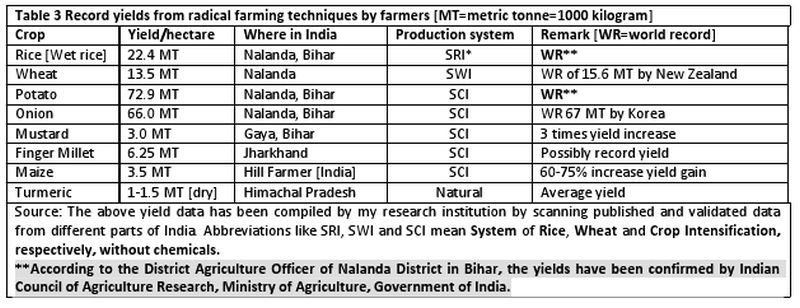
While the non-performing scientists lived off public money, India's farmers continued to feed the nation. Many radical farmers achieved record breaking yields from moderately good lands and many marginal hill farmers achieved huge yield gains yet their innovations neither discussed during national planning exercises nor properly studied. Table 3 is a short summary of current yields that the world should know. [7]
 |
When Albert Howard came to India in 1905 his first observation was that Indian Ag-scientists were behaving like bureaucrats. In 2013 the truth is that Indian bureaucrats behave like 'know-alls' and the scientists behave like petty bureaucrats.
Neither Green nor Gene revolution technologies have matched the yields of traditional Indian farmers in the 18th and 19th Century in rice and wheat, or any food crop, or any crop for that matter.
Nobel Laureate Joseph Stiglitz meets Nalanda farmersNobel Laureate Joseph Stiglitz called them "scientists." He met the farmers at Sohdih village where 2,000 farmers are growing vegetables and was amazed that the farmers were "prospering with traditional methods in farming ... getting high yields as well." [8] Stiglitz also met Rakesh Kumar, [Cell phone: 92343 37 444] one of the thousands who adopted SCI method in 2008-09. From his 2-acre farm Rakesh's potato yield of 72.9 MT set a new world record. His onion yield of 66 MT per hectare equivalent was close to world record of 67 MT set by Korean farmers. In addition, from his roughly 4080 square feet [0.037 hectare] he got an additional 7 to 10 MT green vegetable. The yields have steadily gone up each season. Another farmer Sumant Kumar, already much written about, set the new world record at 22.4 MT for rice paddy. Their main problem now is shortage of scientific storage facility. A French company ECOCERT certified that the produce was organic.
The District Agriculture Officer [DAO, Cell phone: 94318 18731] says that since 2008 the SCI method have been adopted by around 25 to 30 thousand farmers and these are "operational yield," not "intrinsic yield." My first question to him was how the yield was measured? He said that if the plot was less than one acre [<0.4 hectare] then one unit of 50 square metres was sampled from the centre of the plot and the yield was weighed to calculate per hectare equivalent. If the farm size was greater than one acre two to three sampling units were selected. Majority of farmers in Bihar are small or marginal with fewer than two hectare holding. [9] The DAO also told me that agricultural labour was retrained at Government expense in sowing, tending and harvesting. The farmers revived the traditional green manuring based of 'Dhainch' [10] and cow dung and adopted vermi-compost to keep the soil nutrient buffer at optimum level. This is one example of what Agriculture Extension can achieve with a bit of commitment.
The key point is that these small farmers are producing roughly 30-35 MT of food grains per hectare equivalent per year if only two crops-rice and wheat- is taken into consideration. India's farmers have yet again shown that "maximum sustainable threshold of yield" [MSTY], that is the long term average yield under variable climate forcing without Green or Gene racketeers.
Soil is the soul of infinite life: the science behind nutrient buffer power
Back in the early 1980s while evaluating Green Revolution achievement, Dr Prabhakaran Nair had coined the term "nutrient buffer power," a vital concept that combined soil science with plant life. The problem with majority of scientists was that they either worked with soils or with plants, in isolation, and it was Dr Nair who came up with the idea of combining the two that led to the revolutionary concept. [11] According to him, plants select whatever nutrients they need. It means that soil-the medium that supports plant life-must have all the nutrients in optimum proportion. Since plant uptake of nutrients will deplete the available nutrient, the man task of farmers is to ensure optimum nutrient buffer level. That in essence is the nutrient buffer power concept and that is why he asserted that "Soil is the Soul of Infinite Life." Dr. Nair's scientific explanation of India's primordial agriculture system, just as Sir Albert Howard's five decades earlier, would have insured plentiful nutritious food for all at all times. However, their valuable contribution to soil health and scientific explanation of soil as the soul of infinite life was discarded while the spineless scientists destroyed soil health, aquatic life, underground aquifers, people's health, and the planet's health.
Productivity is inversely proportional to wastivity
Wastivity is an important concept in System's theory which essentially means that systemic productivity should factor in wastivity to arrive at net productivity. If a farmer produces 4000 kg of rice every season per hectare, his productivity is recorded as 4000 kg/hectare. However, if the net availability/usability to consumers is only 2000 kg, the net systemic productivity is 50% and wastivity is 50%. Wastage occurs at harvesting, transportation, storage, processing, and delivery to retail chains like Wal-Mart. Around 15% is wasted by the households largely due to marketing gimmickry of multi-brand super stores enticing them to buy more than what they need.
Therefore, from the time a farmer sells his produce to the market and up the value chain to the end user, wastage at each point in the value chain should be known to estimate the net productivity.
And therefore systemic productivity is inversely proportional to wastivity. Every farmer keeps some food grain for his consumption and sells the surplus in the local wholesale market. Farmer's role is over after that. He has produced what he could; the rest is up to public or private sector transportation, handling and storage system to manage. The Government of India has failed consistently since 1947 despite a brilliant research based recommendations by Indian economists and statisticians in 1946 that India's farmers need scientific storage facilities with a system of protection from market manipulations. [12]
Government estimates peg post harvest losses at around 20% for food grains and 40% for horticulture produce in India. Ministry of Food Processing Industry [MoFPI] estimated that food worth Rs. 580 billion is wasted post harvest but erroneously concluded that “food processing industry†can reduce waste. If that had been true, USA and UK would be setting standards! [13]
A recent report from UK shows that 50% of the food produced by farmers is wasted from the time it is harvested to the belly of the most wasteful beast and mainland Europe is nearly as wasteful. Some years ago an American scientist had calculated that Britain and USA alone waste over Rs. 5,500 billion worth of food every year. [14] China wastes Rs. 176 billion worth of food every year when 128 million Chinese remain hungry. [15] Estimate of global waste is not known because waste data is not rigorously gathered. The irony is that richer countries are more wasteful and, as some analysts say, ‘western countries have no culture of respecting food’ and that is true for the affluent in China and India as well. Should we then blame the farmer for not producing enough?
The lies of agricultural bio-technology industry
Biotechnology industry's website [16] makes fraudulent claims that biotechnology can heal the world, fuel the world and feed the world. Twenty years of compulsive and habitual lying stood exposed when Dr. Doug Gurian-Sherman saidtransgenic herbicide-tolerant soybeans and corn have not increased operational yields."[17] Plant pathologist Dr. Don Huber warned that the use of glyphosate, a lethal pesticide but vital for genetically engineered plants, cansignificantly increase the severity of various plant diseases, impair plant defence to pathogens and diseases, andimmobilize soil and plant nutrients rendering them unavailable for plant use." [18] In an interview Dr. Huber further elaborated that micronutrients such as manganese, copper, potassium, iron, magnesium, calcium, and zinc are essential to human health. All of them can be reduced in availability by glyphosate; mineral nutrients are less in glyphosate treated plants. We are seeing a reduction in nutrient quality (in food crops).Years ago Dr. Nair had warned that "an alien gene in a plant cell may adversely impact the concentration of a specific nutrient on its roots and it is the mean concentration of the specific nutrient on the surface of the root that decides its uptake process." Essentially, the alien gene disrupts nutrient uptake and because plant roots and soil biota have symbiotic relationship, GE plants and glyphosate kill the living soil. Dr. Huber has explained sterility and aborted foetus in animals brought up on genetically engineered fodder and food. [19]
Driven by globalist-corporatists-eugenicists, agriculture biotechnology is essentially a military agenda of Monsanto and its cohorts, the US Government, US-Department of Defence, US-AID, the vampire Bill and Melinda Gates Foundation [BMGF], and the Ford and Rockefeller foundations to destroy and take control of world's food system. At least 300,000 farmers have already committed suicide and 148 million farming households are in their cross-hair in India. [20] The grain bowls -Punjab and Haryana- are now dead zones with stagnant yield, increasing costs, stressed natural resources, poisoned land and dying farmers.
Reports of farmers' suicides are pouring in from all parts of India and many parts of the world.
The world doesn't need modern technology of poisonous pesticides, destructive fertilizers and patented GE seeds that can't match 1890 or even 1760 AD yields in India. Modern technology has actually destroyed the nutrition in common foods. Failing to set any yield or nutrition standard in any food crop, an insane industry has muddled through.
Historically, Indian farmers have shown the world that all the food that is needed can be grown sustainably and honest scientists have explained that it can be done in perpetuity! Life flows from the soil and soil supports all life forms on earth; plants transfer soil nutrients to other living beings. Farmers keep us alive and hold up the sky; they alone have the solution to hunger and malnutrition. Endnotes:
[1] Prime Minister Man Mohan Singh and Minister for Agriculture Sharad Pawar are forcing Ag-Biotechnology on India despite unanimous rejection by members of the Standing Committee on Agriculture in the Parliament. The full report here: http://164.100.47.134/
[2] Mankombu Sambasivan Swaminathan, aka MS Swaminathan, reminds me of a 1978 story "Maneater of Manatu" by a colleague that described how one criminal landlord of Bihar used to brutalize the Dalits who worked his lands. Mankombu is man-eater of honest scientists.
[3] Indian agriculture before modernization; Centre for Policy Research; Chennai; http://cpsindia.org/index.php/
The data comes from the records of the Department of Revenue, Agriculture and Commerce gathered for tax purpose, British Indian Government
[4] India's Once Plentiful: Records reveal British schemes diminished crops and dismantled a native system of abundance.http://www.infinityfoundation.
It should be noted that many rice varieties collected by an eminent rice expert Dr Richharia gave 8-9 MT per hectare yield. These germplasm were stolen by Syngenta.
[5] FAO database, 2013
[6] http://www.nutrition411.com/
[7] This summary is based on various reports appearing in national and international media. Researchers should also refer to a vital publication "FOOD FOR ALL" by Centre for Policy Studies, Chennai, which is a compilation of discussions by India's top leaders.
[8] Joseph Stiglitz was in Patna, the state capital of Bihar in January 2013. He took time to visit these villages where new world records are being established. See here: http://articles.timesofindia.
[9] In my opinion, this sampling unit is inadequate when probability of variation is high. Ideally, from a plot of one hectare about 0.4 hectare should be sampled by dividing the plot into a grid of 10 x10 metres and then randomly selecting sub-plots totalling 0.4 hectare, particularly because it is a system based on integration of traditional and vermi-compost based soil management. Also, the edges of the plot are frequently subjected to human traffic. The Chinese Professor Yuan Longping's main reservation is on the method of weighing which is understandable. See here: "India's Rice Revolution: Chinese scientist questions massive harvest" ; The Guardian; Feb 23 2013; http://www.guardian.co.uk/
Orignal Article Here


