Showing posts with label forest. Show all posts

Saturday, 12 January 2013

Forestry - Definition and Types of Forestry

Forestry is defined as the theory and practice of all that constitutes the creation, conservation and scientific management of forests and the utilization of their resources (Anon, 1966). It includes all thinking and all actions pertaining to creation and management of forests, including harvesting, marketing and utilization of all forest products and services. It includes not only management of existing forests but also the creation of new forests.

National Forest Policy of 1952, recommended that on the basis of Functions, all forest lands may be classified into:

A. Protection Forests
B. National Forests
C. Village Forests
C. Tree Lands

National Commission of Agriculture (1976) proposed that forests can be classified into:

A. Protection Forests:

The practices of managing the forests for their protection function are called Protection forestry. In protection forestry, the object is to protect the site due to instability of terrain, nature of soil, geological formations, etc. Such areas where manipulation of the forest cover is not desirable may be classed as protection forests. The forests located on higher hill slopes, national parks and sanctuaries, preservation plots, biosphere or nature reserves and wilderness areas may be included under protection forests. The practice of forestry with a view to conserving flora, fauna, soil and water, increasing water yields, reducing floods and droughts, amelioration of climatic conditions, etc. is called Protection Forestry.

B. Production Forests:

The practice of forestry with object of producing maximum quantity of timber, fuel wood and other forest produce is called Production Forestry. The production forestry can be further classified into:

(i) Commercial Forestry: Commercial forestry aims to get maximum production of timber, fuel wood and other forest products as a business enterprise.

(ii) Industrial Forestry: Industrial forestry aims at producing raw material required for industry. In Production forestry, there is a greater concern for the production and economic returns.

(iii) Mixed Quality Forests
(iv) Valuable Forests
(v) Inaccessible Forests

C. Social Forests: Social Forestry is the practice of forestry which aims at meeting the requirement of rural and urban population. The object of social forestry is to meet the basic needs of community aiming at bettering the conditions of living through:
(i) Meeting the fuel wood, fodder and small timber requirements
(ii) Protection of agricultural fields against wind
(iii) Meeting recreational needs and
(iv) Maximizing production and increasing farm returns

Various forms of Social forestry are:

a) Community Forestry: The practice of forestry on lands outside the conventional forest area for the benefit of local population has been called Community forestry. Community forestry seeks the involvement of community in the creation and management of such forests.

b) Farm Forestry: Farm Forestry is defined as the practice of forestry in all its aspect on farms of village lands generally integrated with other farm operations.

c)Extension Forestry: Extension forestry which includes the activity of raising trees on farm lands, villages wastelands and community forest areas and on lands along the sides of roads, canal banks and railway lines (Anon., 1976). More recently, there has been emphasis on dynamic land use planning and efforts are made to maximise production on farmlands under agroforestry.

d) Agro-Forestry: Agro-forestry has been defined as a sustainable land management system which increases the yield of the land, combines the production of crops and forest plants and/or animals simultaneously or sequentially on the same unit of land and applies management practices that are compatible with the cultural practices of the local population.

e) Recreational Forestry: More recently, there has been considerable demand for Recreational forestry, which is defined as the practice of forestry with the object of developing and maintaining forests of high scenic value. Recreational forests are being developed near towns and cities. The areas are being planted with flowering trees, shrubs and creepers to provide forest atmosphere near towns and cities.
Original Article Here

Friday, 11 January 2013

Productive Functions of the Forests

1. Forests are valuable natural resources. The goods provided by the forests are of immense importance to animals and mankind. Wood is a major forest produce and it is extensively used for various purposes. In India, most of wood produced is used for construction of house, agricultural implements, bridges, sleepers, etc. In India about 12.5 million cubic metres of timber is produced from the forest. Many species e.g. teak, sal, deodar, sissoo, babul, chir, haldu, axlewood, rosewood, dipterocarps, etc yield valuable timber.

2. Wood is a universal fuel, Approximately 175 million cubic meters of wood is used as fuel in the country, most of which is obtained from the forests.

3. Forest provides raw material to a large number of industries e.g. paper and pulp, plywood and other board, saw mills, furniture making, packing cases, match boxes and toys.

4. A large number of non-wood products are also available from forests.

These are commonly called Minor Forest Products (M.E.P.) not because these are of minor significance but since they are harvested in smaller quantities. Some of the important minor forest products are as under:

(i) Fibros and Flosses: Fibros are obtained from best tissues of certain woody plants which are used for making ropes. Flosses are obtained from semal (Dombax ceiba) and kapuk (Ceiba pentandra).

(ii) Grasses and Bamboos: A large variety of grasses are found in the forests. About 20 per cent of 419 million livestock graze in the forests. Among valuable grasses, sabazi (Eulaliopsis binate) is harvested annually to the tune of about 80,000 tonnes. About 5.5 million tonnes of bamboo is harvested from our forests every year.

(iii) Essential Oils: India produces about 1500 tonnes of essential oils from forests every year. It utilizes in making soaps, perfumes, detergents and chemicals. Many species e.g.Eucalyptus spp., Bursera spp., Cymbopogon spp,Santalum album, etc. produce these oils.

(iv) Oil Seeds: Many tree species, e.g. Madhuca indica, Pongamia pinnata, Shorea robusta, Azadirachta indica, Schleichera oleosa, Vateria indica,etc. produce oil bearing seeds which are commercially important. Some of these oils can be made fit for human consumption. Presently these seeds are used in soap industry. Tribals use these oils for various purposes. There is a potential of production of about 1 million tonnes of oil every year from forest tree seeds.

(v) Tans and Dyes: A variety of vegetable tanning materials are produced in the forests. Important vegetable tanning materials are the myrobalan nuts and bark of wattles (Acacia mearnsiii, A. decurrens. A. nilotica and Cassia auriculata, etc. Katha and cutch are obtained from Acacia catechu trees.

(vi) Gums and Resins: Gums and resins are executed by trees as a result of wound or injury to the bark of wood. Gums are collected from several tree. Species, viz. Sterculia urens, Anogeissus latifolia, Lannea coromandelica, Acacia nilotica, Cochlospermum religiosum, Pterocarpus marsupium, Butea monosperma etc. Resin is obtained from Pinus roxburghii. (Chirpine)

(viii) Tendu Leaves and Other Leaves: Tendu leaves are used to produce bidi and therefore, these are also called bidi leaves. Annual collection of tendu (Diospyros melanoxylon) leaves is about 90,000 tonnes in the country. Madhya Pradesh alone contributes about 45 per cent of this quantity. Leaves of trees such as, Bauhinia spp,Butea spp, etc. are used for making plates, drona, etc.

(ix) Edible Products: Fruits, flowers, seeds, tubers, etc. of several forest species are eaten. Anacardlum occidentale, Tamarindus indica. Syzygium cumini, Emblica officinalis, Buchanania lanzan, flowers of Madhuca indica, green pods of Moringa oleifera, new shoots of bamboo, etc. are in great demand.

(x) Lac and Other Products: Lac is a resinous secretion of the lac insects which feed on forest trees, particularly of Butea monosperme. Similarly, silk is another important product from forests. It is obtained from the cocoons of silk worm. Silk worm is raised on Terminalia alata and Morus alba plantations for obtaining silk. Honey is another product which is obtained from forests.

(xi) Fodder and Grazing: Forests provide fodder leaves and grazing facility to the rural animals. About 20 per cent livestock population depends upon forest grazing and leaf fodder supply. Leaf fodder of several tree species is almost as nutritious as that of agricultural fodder crops. Good fodder yielding tree species include; Ailanthus excelsa, Moringa leifera, Sesbania spp,Morus alba, Albizia excelsa, Moringa leifera, Sesbania spp., Morus alba, Albizia lebbeck, Leucaena leucocephala, Pongamia pinnata Hardwickia binata, etc.
Original Article Here

Protective and Ameliorative Functions

1) Forests play a significant role is maintaining the CO2 balance in the atmosphere. Without sufficient forest cover, the CO2 which is released in the atmosphere will not be utilized completely resulting higher per cent of the CO2 in the atmosphere. The CO 2 per cent in the atmosphere has already reached 0.042 per cent against the normal of 0.030 per cent. If this increases continuous higher temperature and other disturbances on the earth may bring about un-imaginable miseries to the mankind.

2) Forests increase local precipitation by about 5 to 10 per cent due to their Geographic and micro-climatic effects.These create condition favorable for the condensation of the clouds.

3) Forests reduce temperature and increase humidity.Temperature in the forests is 3° to 80 less than the adjoining open area.

4) Forests maintain the productivity of the soil by adding a large quantity of organic matter and recycling of nutrients. The leaves of trees are used as manure. Supply of firewood from forests releases dung for the use as manure.

5) Tree crowns reduce the violence of rain and check splash (sound) erosion. Forests, increase infiltration and water holding capacity of the soil resulting in much lower surface run-off. This in turn results in checking of soil erosion.

6) Forests check floods.They intercept 15 to 30 per cent of the total rainfall. They increase infiltration rate and water holding capacity of the soil. This results in reduced surface run-off and checks erosion. Mostly floods are caused due to siltation of river channels, caused due to erosion and higher peak discharges caused due to greater surface run-off.

7) Forests conserve soil and water both.

8) Forests and trees reduce wind velocity considerably.Reduction of wind velocity causes considerable reduction in wind erosion, checks shifting of sand dunes, and halts the process of desertification.

9) Forests, by reducing erosion check the siltation of irrigation and hydral reservoirs.

10) Forests are the store-house of genetic diversity.Several unknown plants may have potential for medicines and food.

11) Forests protect from physical, chemical and noise pollution. Duct and other particulate and gaseous pollutant cause serious problems, forests protect us from such pollutants.

12) Forests and trees provide shelterbelt and windbreak effect which is beneficial to agricultural crops, particularly in arid and semi-arid areas. Shelterbelt and windbreak increase agricultural production.
Original Article Here

Developmental Functions

1) Forests provide employment to a large number of people.

2) Forests and various forest activities help tribal to improve their socio-economic condition through collection, processing and marketing of various forest products and by providing gainful employment.

3) Forests help to earn a good sum of revenue to the government which is used for various developmental works. During every year forests gives revenue worth of about more than Rs. 20,000 million.

4) Development of ponds / conservatories for fisheries.

Problems and Constrains in Forest Development

i. Loss of forest areas for different purposes.
ii. Encroachment of people on forest land.
iii. Cutting due to heavy demand for wood, industry, home fuel
iv. Excessive grazing of animals
v. Fires - incidences / attacks / problems
vi. Shifting cultivation - Tonguya etc.
vii. Inadequate finance
viii. Non - involvement of people
ix. Different projects - irrigation / power / thermal / canals
x. Ecological balance
xi. Man hindrance

The basis for Classification of Forest Types

1. Physiognomy: Evergreen / deciduous habit, very dry, wet
2. Structure: Covers stratification, dimensions, ht/spaciy
3. Function: Morphological characters
4. Floristic: Families, genus, sps.
5. Dynamics: Vegetation change, Force in motion
6. Habitat: Climatic and edaphic factors
7. Physiography: Aspect / altitude
8. History: Past History of site.

Branches of Forestry

Mainly, the forestry has been grouped as follows:

1. Basic Forestry
2. Applied Forestry

1. Basic Forestry: Basic Forestry deals with the theory and practice of constitution and management of forests and utilization of their products. Agriculture is the study of science and art of production of plants and animals used by man In India, the geographical, areas is about 32,80,500 km2. The forests occupy about 7,50,000 km2. (22.9% approximately) whereas agricultural (cultivated) area is about 46% However, agriculture is the largest enterprise in India. Nearly, 70% of the population is employed in this profession. But unfortunately, in spite of this, it is not able to meet the requirements of ever-increasing population. Forestry, just like agriculture, is a good professional with the difference of long life-span.

Basic Forestry has the following Branches:

A) Silviculture: This refers to certain aspects to theory and practise of raising forest, crops, methods of raising tree, their growth and after-cares up to the time of final harvesting. However, in simple words, it is the cultivation of forest trees.

B) Forest Mensuration: In simple language, it is the measurement of forest produce. However, it is defined as the determination of dimensions (e.g. height, diameter, volume, etc.) from, volume, age and increment of single trees, stands or whole woods, either standing or after felling. It concerns with linear area, volume and weight measurements.

C) Silvicultural Systems: A Silvicultural system can be defined as a method of Silvicultural procedure worked out in accordance with accepted sets of Silvicultural principles by which crops constituting forests are tended, harvested and replaced by new crops of distinctive forms.

D) Forest Management: It is the practical application of science, technique, and the economics to a forest estate for the production of some wanted results. In actual sense, it is the application of business methods to the operation of a forest estate. The Society of American Foresters (SAF) has described it as an application of business methods and technical forestry principles to the operation of a forest property.

E) Forest Utilization: It is a branch of forestry concerned with the harvesting, conversion, disposal and use of forest produce (British Common Wealth Forest Terminology, 1953.).According to SAF (1983) it is a branch of forestry concerned with the harvesting, any necessary processing, and delivery to the consumer of forest produce.

F) Forest Law: Law includes any rule of action. The rules and law imposed by the state up on the actions of its citizens for the breach of which they are punishable. Forest law is classified as:
a) Constitutional laws
b) Public laws
c) Private laws; Very essential for protection of forest; Some terms - Forest offence / Forest right / Forest settlement
d) Forest wild life Act WL (protection ) Act 1972 Animals / bird.

G) Forest Policy: Branch of forestry concerned essentially, with social and economic aims underlying forest management and forestry development (SAF - 1983)

2. Applied Forestry: This includes those subjects which how the references to other subject but make the essence of, forestry

a) Dendrology
b) Forest Ecology
c) Forest Economy
d) Forest Entomology
e) Forest Fire
f) Forest Genetics
g) Forest Pathology
h) Forest Seed technology
i) Forest soils
j) Forest statistics
k) Forests surveying
l) Remote sensing
m) Social Forestry-Social Resent
i. Agroforestry
ii. Forestry Extension
iii. Afforestation
iv. Recreation Forestry etc.

Some Other Forestry Branches:

1. Aesthetic forestry
2. Commercial Forestry
3. Community Forestry
4. Extensive Forestry
5. Farm Forestry
6. Extensive Forestry
7. Multiple use Forestry.

Silviculture

Silviculture is an important subject of forestry. It is tie forestry as Agronomy in to agriculture, in that it is concerned with the technology of crop production. It has been defined in a number of ways. Following are the accepted definitions of silviculture.

1. Silviculture is that branch of forestry which deals with the establishment, development, care and reproduction of stands of timber. By Tourney and Karstien

2. Silviculture is the art and science of cultivating forest crops. By Indian Forest and forest products Teminology (1957)

3. Generally, The science and art of cultivating (e.g. growing and tending) of forest crops, based on a knowledge of silvios. More particularly, the theory and practice of establishment, composition, constitution and growth of forests. By Society of American Foresters (1983)

4. Silviculture refers to certain aspects of theory and practice of raising forest crops, methods of raising tree crops, their growth and after care up to the time of final harvesting. By Rao (1987)

In simple words, Silviculture is the growing and tending stands of trees. Silva is the Latin word for forest and culture for cultivation. Therefore, without exaggeration, Silviculture is the Real art of forest.

Silviculture is very important and essential when human beings wish to manage the forests.

a. To accelerate the wildlife, timber and forage production.
b. To increase the Recreation values and Watershed values.
Original Article Here

Foundation of Silviculture

The closest foundation of silviculture in the natural sciences is the silvics. It deals with the principles underlying the growth and development of single tree and of the forest as a biological unit. It can be defined in the following ways:

1. The study of life history and general characteristics of forest trees and crops, with particular reference to environment factors, as the basis for the practice of silviculture.

2. The study of requirements and the processes of tree growth and the environment under which it takes place is called silvics. Stodard and Stodard (1987)

Therefore, intelligent management of the forest must depend upon a solid foundation of knowledge of silvical processes.

The practice of silviculture is related to the social as well as the biological aspects of forestry. It is regarded as the crown of the forestry. It helps in achieving the five F's. Viz,

1. Food / Fruit
2. Fodder
3. Fuel Wood
4. Fibre
5. Fertilizer

These are immediate (primary) needs of the society particularly in the rural areas. In addition to these primary needs, some other needs, which are called secondary need, are also fulfilled by silviculture. Following are the secondary needs:

1. Nitrogen Fixation
2. Soil Conservation
3. Mulch Farming
4. Windbreaks and Shelterbelts
5. Commercial Timber, etc.

Therefore, study of silviculture is very important now days. In actual sense, it is the base of forestry.It has good relations with various branches of forestry.
Original Article Here

Functions & Types of Forest in India


Function of forests:

Sr.No.
Particulars
Functions
1
Productive
They provide timer, fuel, charcoal, beedi , leaves, was and resins, fruits, tanning, materials, manure leaves, grass, bamboo, gums, lac etc.
2.
Protective
Forests protect water sheds, catchments of rivers and streams against erosion.
3.
Aesthatic
Forests add good appearance, landscaping and a thrilling atmosphere to the locality.
4
Recreational
Forest provides picnic resorts and opportunities for sport like hiking, trekking, wild life watching, bird watching.
5
Scientific
Study of ecological process can be made
6
Ameliorative
Forests improve climate and reduce pollution 
7
Hygienic
Forests improve the environment and help in reduction of noise, purify the air and give out oxygen to the atmosphere.
8
Industrial developments
Forest meet the need for raw material for industrial development such as Paper pups, rayon grade pulp, saw milk ply wood, hard board etc.

Forest types of Indian:
  • Tropical wt ever green forest
  • Tropical semi evergreen forest
  • Tropical moist deciduous forests (Southern and northern types)
  • Littoral and Swamp forests
  • Tropical dry deciduous forest
  • Tropical thorn forest
  • Tropical dry ever green forest
  • Sub tropical broad leaved hill forest
  • Sub tropical dry evergreen forest
  • Mountain wet temperate forest
  • Himalayan moist temperature forest
  • Sub alpine forest
  • Himalayan dry temperate forest
  • Sub alpine forest
  • Most alpine scrub
  • Dry alpine
The above types are called natural ecosystems. Ecosystems are the natural climax forests, resulting from a long process of ecological succession of plants and associated animals life, undisturbed by man.

Branches of Forestry

Forestry has five different branches:

1. Silviculture:
If refers to certain aspects of theory and practices of raising forests crops, methods of raising tree crops, their growth and after care up to the time of final harvesting.

2. Mensuration:
It deals with the measurement of forest produce ex. Dimension from volume, age and increment of individual trees and forest crop.

3. Silviculture system:Process by which the crops constituting a forest are tended, removal and replaced by new crops

4. Management:
Practical application of sequence technique and economics to forest estate for the production of certain desired results

5. Utilization:
Branch of forestry which deals with harvesting, marketing conservation and applying the forest produce to a variety of uses eg. Timber, fuel, charcoal, pulp wood, ply wood.

Forestry:

The theory and practice of all that constitutes the creation conservation and scientific management of forest and the utilization of their resources, based on the aims or objectives, the forestry may be:


Protection of Environmental forestry: Protection of land, regulation of water cycle, Wild life conservation Modernization of climate conditions, combination of above. Ex. Buddha Jayanti Park at New Delhi.


Commercial or Production forestry: Timber and other raw materials.

Social Forestry: Raising forests outside the traditional forest with the involvement of society.
Farms Forestry: Raising forest trees on farms lands. It is further classified as:
Non commercial farm forestry: raising of trees by individuals for domestic needs (usually by the farmers)
Commercial farms forestry: Farmers grow trees on commercial basis on farmlands.


Community forestry: Raising of forests of public or community land

Urban forestry: Management of public and private owned lands in and adjacent to urban centres. They have more aesthetic value.


Agro Forestry: Cultivating forest trees along with agricultural crops.
Original Article Here

Saturday, 8 December 2012

Degraded land gets one more shot at life


by Cecilia Schubert
A discussion on the restoration of degraded lands would not rivet most people. That is, not until they realise that without good land, farming becomes impossible, and without farming, there is no food.

At a side event organised by the The International Union for Conservation of Nature (IUCN) alongside the UN Climate Talks in Doha, experts and ambassadors spoke passionately on the need to restore degraded land, to safeguard the future of farmers, indige
nous people, forest communities, small villages, pastoralists, and others who depend on the food they produce.

One of the session's expert panelists, Pak Kuntoro from Indonesia, was so engrossed in the topic that he sat with his back to the audience, intensively following the other presenter’s slides on the big screen.

The topic goes hand in hand with the themes ofAgriculture, Landscapes and Livelihoods Day (ALL5) held earlier this week: how to transform rural landscapes to be more food secure in a changing climate, using holistic, sustainable approaches.

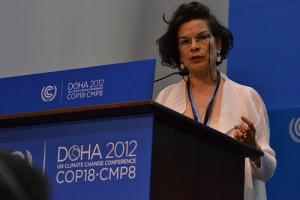
The event got off to a great start with an inspiring speech by Bianca Jagger,goodwill ambassador for “Plant a Pledge” – an online campaign to mobilize public support for a major land restoration initiative led by the IUCN, andspeaker at Forest Day a few days earlier.

“This has been the era of procrastination” she said to a full-packed room, “and now we see the consequences.”

Restoring areas that have been degraded is one way to improve our gloomy future predictions. At the moment, countries have pledged millions of hectares to the campaign Plant a Pledge, which aims to restore 150 million hectares of forest and degraded land by 2020. This is equivalent to 15 per cent of the estimated area of degraded forests worldwide.

Proof from the field

There are thus many activities going on at the moment, but one example where results are already visibleoundn China. Launched in 1999, the Grain for Green Programme restoration project focused on the Loess Plateau area in China, where there was a degraded area covering 624,000 km2 of which over 60 per cent faced severe erosion. Between 2000 and 2008, the area of land use conversion had already amounted to 2 million ha and benefitted 2.5 million households.

Read more about this and other successful case studies on Climate Smart Agriculture presented during the conference.

Restored land can be put into use for agriculture to improve yields, regenerate forests and vegetation, agroforestry systems, and lake side planting to protect people from storms and much more. There is thus a lot to win for plenty of stakeholders from restoring abused and mismanaged lands.

“You will fail if you fail to have the local community’s support”

A restored landscape will only stay like that however, if the community is involved. They need to be engaged in the activities and alternative livelihood-activities should be presented. Otherwise trees might be cut down again in an unsustainable matter.

This was also something on Pak Kuntoro’s mind when he showed a picture of indigenous Indonesian tribes living in and by the tropical forest. “You fail if you fail to have the local community supporting your program” he said repeatedly, because at the end of the day, “it is they who protect the forest and they could care less about carbon”. “They don’t even know what carbon is,” he shouted passionately.

"We can sit and put a price on carbon, while people are managing, and caring for our remaining forests around the world, because they depend on it and value its benefits. We should be supporting them instead," he said.

But restoring lands under a landscape approach will come with trade-offs. There will be decisions on where to expand agriculture, in order to meet future food demands, and which parts of the surrounding forest should be restored.As agriculture is the leading cause of some 75 per cent of global deforestation,it is important that the two sectors work together when planning for a sustainable landscape that benefits rural communities.
Original Article Here

Monday, 12 November 2012

Agriculture and forestry: mainstreaming research findings that work for communities


BY GABRIELA RAMIREZ GALINDO


PUNTA DEL ESTE, Uruguay (12 November 2012)_Small-scale farmers in many tropical nations depend primarily on their crops for survival, but without additional income generated by nearby forests, they would often be unable to weather through the hard times. This is why agricultural and forestry institutions should partner up when conducting research aimed at determining activities that will be most beneficial to communities and the environment, said scientists with the Center for International Forestry Research.

The perception often is that farmers only do one thing: farm.

“But growing or managing forests for wood and non-wood products, both for subsistence and sale is very common. “It is also a very sensible strategy, both in terms of maximising incomes and minimising risk,” said Peter Kanowski, Deputy Director General of CIFOR, at the Second Global Conference on Agricultural Research Development (GCARD2) in Uruguay. The conference discussed hopes for a future where agricultural innovation ratchets up production, and the welfare of small-scale farmers is assured.

Added Robert Nasi, Director at the CGIAR Research Program on Forests, Trees and Agroforestry: “This is what we are implementing in our forest, trees and agroforestry research program — working together with other research institutions and partners that span across the whole agriculture-forest gradient.”

Forests cover a third of the earth’s surface and one billion people depend on forest resources for their everyday lives. Forests also provide essential services to mainstream agriculture, meaning future food supplies could be compromised should deforestation continue at a staggering pace.

Research from the Poverty and Environment Network (PEN), the largest and most comprehensive global analysis of tropical forests and poverty indicates that on average 75 percent of the incomes of small-scale farmers comes from their crops.

But it’s the remaining 25 percent, primarily from the forest, that is often most important,

Especially, said Nasi, “during periods of crisis…when you have a drought, when you have food shortages.”

This rich, natural habitat provides a second source of income — through the sale of meat, wild fruit, bark, medicines, and micro-nutrients — but also contributes in indirect ways, by providing ecosystem services to the yields and crops, like water regulation and pollination.

And this is key, not just for farmers to understand, but for agricultural and forestry researchers, as well.

“They have to recognise that they are just of the same portfolio,” said Kanowski, adding that only by partnering up will researchers be able to deliver outcomes that work for communities.

Farmers also need to understand the risks of having farmers invest all of their land and labor producing a single crop (for biofuels or for feedstocks for animals, for instance).

Small-holders would be better off diversifying their activities, drawing from trees and other products in the forests and — depending on their situation — on some food crops.

The benefits are in income, but also in terms of resiliency and risk management.

CIFOR, an organisation with more than 200 researchers and support staff, would not be able to carry out its work if it didn’t team up with other researchers who are based in institutions and in countries with complementary skills, Kanowski said.

“On one level, partnerships are fundamental to actually doing our research, and on another, our research relies on partnerships to have an effect,” he said.

“We rely on partnerships in varying forms for our audiences to hear and understand the results of our research.”

Kanowski said he and his colleagues also rely on counterparts in the development community, who are working in national implementation agencies, to engage with the research they do.

Together, the research is “translated into implementation strategies, which will change people’s life for the better.”

Nasi concurred: “We have to remind the agricultural world that there is something beyond the fields: forests and trees,” he said.

“We need to keep the flag waving saying ‘We are here, you are not alone’.”

The CGIAR Research Program on Forests, Trees and Agroforestry: Livelihoods, Landscapes and Governance is lead by the Center for International Forestry Research in partnership with Bioversity International, the International Center for Tropical Agriculture and the World Agroforestry Centre. The centers collaborate with leading national research institutes and other organisations to maximize outreach and share research results with policy and practitioner partners , who can use and share this knowledge on the ground in the developing world.

Original Article Here

Saturday, 10 November 2012

Minister hopeful De Doorns protests will end soon

By Mariska Botha
The Minister of Agriculture, Forestry and Fisheries, Tina Joemat-Pettersson, says a breakthrough is imminent in talks between organised agriculture in the Western Cape, unions and her department over the violent wage protests at De Doorns in the Hexriver Valley. Joemat-Pettersson intervened in the matter earlier this week after talks between unions and Agri Wes-Cape reached a dead end. 

The workers are demanding a wage increase of R150 up from R65 per day. The meeting between stakeholders lasted late into yesterday evening.

Joemat-Pettersson says she's hopeful that the protests will be called off by Tuesday. She says a crises meeting will be called tomorrow with all role players on national level. "We will not allow the situation to get out of control. We'll keep the situation under control and by tomorrow we'll take a proposal to the Minister of Labour and that proposal includes sectoral determination for a change in the minimum wage of the farm workers,' she says.

Meanwhile, unions say after a week's protests no results were yielded and that the actions will continue.

Cosatu says it believes that other farm workers in the country will join in the protest action. "The government has a responsibility to get involved in raising the wages. The government can set that R150 through the employment conditions commission so it can make it law. The government must now tell workers it's going to do that because that's the only way we think the protest will come to an end where the government stands up and says we're going to force the employers and work with the labour to ensure that that R150 or a living wage is promulgated for the agricultural sector," says Cosatu's Tony Ehrenreich.

Agri Wes-Cape could not be reached for comment.
Original Article Here

Monday, 10 September 2012

Department of Agriculture and Rural Development : 10 September 2012 - O’Neill announces fresh investment in a range of On-farm Renewable Energy Technologies

Agriculture Minister Michelle O'Neill today re-affirmed her commitment to the support of renewable energy in the agricultural sector by announcing the re-opening of the EU co-financed Biomass Processing Challenge Fund.
~ Monday, 10 September 2012

The Biomass Processing Challenge Fund (BPCF) aims to encourage agricultural and forestry businesses to install biomass fuelled technologies primarily to aid agricultural activities at farm level. The Fund can provide capital grant assistance of up to 40% with a ceiling of approximately £320,000 per project.

The Minister recently visited the Blakiston-Houston farm in Carrowreagh, County Down to view the Anaerobic Digester which was installed at the premises with support from the BPCF. This dairy, beef and arable farm utilises cattle slurry with a percentage of grass silage to produce heat and electricity to be used on-farm in direct support of agricultural activities.

Following her visit, the Minister said: "It is good to see a successful renewable energy project in operation and I am pleased that my department was able to offer assistance to it and other renewable installations.

I support the development of on-farm renewable energy technologies and I recognise that they can be hugely beneficial to local farmers by improving their resource efficiency and providing a secure source of renewable energy which will in turn enhance farm profitability."

The Minister added: "I am encouraged at the significant impact tranche one of the BPCF has had in encouraging uptake of on-farm renewable technologies. However with the cost of capital construction remaining high and with limited availability of private finance, I believe that the time is right to re-open the Biomass Processing Challenge Fund for applications. I remain mindful of the challenges faced by potential applicants in procuring private finance and confirming the necessary legal permissions. To allow farmers to address these issues, I will open the Fund for an extended application period of 12 weeks. I hope to see farmers coming forward with applications incorporating a range of renewable technologies and look forward to my department supporting projects with viable economic and technical business cases which evidence how renewable energy technologies can benefit the farming enterprise."

The Minister highlighted that she wanted to see the agricultural sector make a meaningful contribution to the government target of producing 40% of electricity and 10% of heat from renewable sources by 2020. She added: "I firmly believe that assistance with capital installation is vital to ensure that these targets are met and I hope that all farmers will give serious consideration to the adoption of renewable technologies on-farm. I am confident that such technologies can benefit every farmer in the north of Ireland, regardless of the size of their holding."

Applications to the fund are welcome from individual farmers and groups of farmers. The Biomass Processing Challenge Fund is part of the Greenhouse Gas strategy and action plan (Efficient Farming cuts Greenhouse Gases). Fund details including application forms are available for download here.

All BPCF documents can be made available, on request, in alternative formats and other languages.

The BPCF will be open to applications for 12 weeks from Monday 10 September 2012. No applications will be accepted after 4pm on Friday 30 November 2012.

The BPCF is managed under the European Sustainable Competitiveness Programme for NI 2007 - 2013 and is part financed by the European Regional Development Fund (ERDF) under Priority 3 - Improving the Accessibility and Enhancing the Environment.

Original Article Here

Tuesday, 4 September 2012

Agriculture department to relocate

Eight hundred Department of Agriculture staff are to move to a former military barracks at Ballykelly in Co Londonderry.

The headquarters will shift from Dundonald House at Stormont by 2015, minister Michelle O'Neill said.

The 700-acre site at Shackleton base has been gifted to the Northern Ireland Executive by the Ministry of Defence.

Ms O'Neill said: "The relocation will stimulate the local economy through increased local spending, provision of high quality and well-paid public sector jobs and potentially jobs associated with the construction and ongoing servicing of the new HQ.

"The relocation will also help to share wealth across the wider economy and contribute to better-balanced economic growth, by starting to address disparities in the distribution of public sector jobs in the north of Ireland."

The agriculture minister announced on May 17 that she had tasked the chief executive of the Forest Service with starting the process of looking for locations in Co Fermanagh for a new Forest Service headquarters.

She said: "The relocation programme is an important first step to relocate a significant share of public sector jobs to rural areas as recommended by George Bain in his 2008 report into the location of public sector jobs across the north.

"To relocate my department's HQ to a rural area is a key target in the Executive's Programme for Government 2011-15 and I am therefore pleased to be able to announce this significant step towards achieving this target."

Copyright © 2012 The Press Association. All rights reserved.

Wednesday, 4 July 2012

Making sense of sustainable agricultural intensification


By Cecilia Schubert
As world food demand increases, so too does demand for farmland. Agricultural expansion threatens valuable forests and biodiversity, contributing to climate change and destroying precious ecosystems. Seeing as a country’s GDP growth from agriculture generates at least twice as much poverty reduction than any other sector, and 40 percent of the world’s population is engaged in farming, agriculture must be viewed as key for economic growth, food security, poverty reduction and environmental sustainability. Agriculture has huge potential in contributing to the solution, instead of only be seen as part of the problem. Is intensification the silver-bullet solution?
This emerging issue was discussed during the Food Security Main event at the Forum on Science, Technology and Innovation for Sustainable Development, held alongside the recent Rio+20 conference.
Intensification is a long-term project
How can agriculture be sustainably intensified? Tim Benton, Professor in Population Ecology at the University of Leeds, pointed out that intensification is not only about  technical solutions or industrialization. It is about increasing growing yields per area. In other words, it is producing more, while minimizing the impact on the environment. It must be viewed as a journey and not something that can be implemented tomorrow, he said. Organic farming is one part of the solution, but it is not the entire solution, he emphasised. Technical interventions including new crop varieties; valuing ecosystem services; use of best practices based on context, management of landscapes and soils are some of the solutions to how to transform the agricultural sector into a more sustainable and intensified production system.
An innovative idea that Benton laid forward was to address intensification across multiple spatial scales. This means intensifying within one area, but sparing more land somewhere else for the conservation of biodiversity and ecological systems.  This can be done within one country, or between countries. There is thus a trade-off between land used for production and the preservation of different ecosystem services that are needed to obtain a good yield such as pollination for instance.
Getting policymakers on board is essential
But the challenge is still how do we ensure that politicians understand what needs to be done? And how do we communicate research to politicians without over-simplifying it, Commissioner Adrian Fernandez. “This is a challenge we need to take” he said, “ensuring that politicians understand our research”. He presented the Commission on Sustainable Agriculture and Climate Change’s seven key recommendations on how to achieve food security in the context of climate change and a growing population. The recommendations were included in a Summary for Policy makers – ensuring that the research is communicated as key action messages, ready to be included into government’s policies. 
Dr. Fernandez concluded his presentation by saying that, business as usual will not bring food security and environmental sustainability. Instead we have to change the way we view agriculture. Agriculture is part of the solution that can help us create a food secure future, with greater prospects for farmers to enhance livelihoods. But there are still challenges left that need to be further investigated. He emphasized that we must not forget the sustainability aspect within sustainable intensification; it is key in order for agriculture to be part of the solution. 
Original article here

Monday, 2 July 2012

Namibia/Palestine Sign Agriculture Mou


Namibia and Palestine signed a memorandum of understanding (MoU) on Friday to co-operate in areas such as the financing of joint agriculture projects, research in agro-technology, food security and more.
At the first-ever agreement signing ceremony on agriculture between the two countries here, Minister of Agriculture, Water and Forestry, John Mutorwa, noted that Namibia supports the just cause of the Palestinian people and their right to statehood.
"Our two countries largely share similar climatic conditions of arid to semi-arid climates, with limited arable land. It is thus imperative to share experiences and technical knowledge in agriculture, more so now with the challenge of climate change, which the entire world is facing," he stressed.
According to Mutorwa, climate change has affected and is affecting Namibia to such an extent that government has identified the country to be highly vulnerable to the negative impact of climate change.
He indicated that for this reason, areas such as the expansion of agriculture and food production, agri-business and increased investments in agriculture, to mention but a few, are some of the projects that could be jointly implemented in the rural areas of Namibia and Palestine.
"Namibia will continue to support the legitimate struggle of the Palestinian people, to achieve their inalienable right to national self-determination and independence. We also support the Two-State nation, a Palestinian state living side-by-side with the state of Israel, in peace and harmony," he noted.
Meanwhile, at the same occasion, Palestinian Minister of Agriculture, Walid Assaf, noted that Israel's obstruction of water and sanitation to Palestinians has hampered agricultural development in his country.
He noted that without the sovereignty of the Palestinians over their natural resources, specifically land and water, optimal development would not happen.
The agreement will strengthen and consolidate co-operation between the two countries, which will exchange know-how in the fields of water, modern irrigation techniques, forestry development, controlling animal cross-border diseases and co-operation in plant protection, medicinal and aroma herbs and modern date planting techniques.
"We are ready to support Namibian farmers with the transfer of technology and training," he noted.
A high-level Palestinian-Namibian Agricultural Committee was appointed to supervise the implementation of the agreement by introducing the co-operation priorities and vital projects for both ministries.
The committee is also responsible for setting up an action plan and timetable to ensure the implementation of the MoU.
The committee will meet once a year to review the progress of the agreed upon co-operation. - Nampa
 Original Article Here

Wednesday, 27 June 2012

Top agriculture official placed on suspension

The Department of Agriculture, Forestry and Fisheries has announced the suspension of director-general Langa Zita
THE Department of Agriculture, Forestry and Fisheries announced the suspension of director-general Langa Zita yesterday, but did not elaborate on the reasons, except to say that they were administrative.
Palesa Mokomele, spokesman for the minister, Tina Joemat-Pettersson, said Sipho Ntombela had been appointed acting director-general.
Mr Zita was barely 20 months into the job and had been introduced by Ms Joemat-Pettersson as an appropriate candidate with the required background and skills, since he had been her special adviser on policy.
Ms Joemat-Pettersson has of late been under pressure from various industry players, including red meat and ostrich producers, who suffered losses after disease outbreaks had led to a ban on exports.
In the fisheries sector, the department was forced to appoint an independent committee of inquiry into procurement procedures. This led to the suspension of a company, Sekunjalo , which had won the department’s R800m vessel management contract, on suspicions of political interference and corruption. The Navy had to take over management of the department’s maritime patrol vessels on April 1 for at least a year.
The fleet include the fisheries research vessels Africana, Algoa and Ellen Khuzwayo and the patrol vessels Sarah Baartman, Lilian Ngoyi, Victoria Mxenge and Ruth First.
The Navy’s functions included the crewing of the vessels, the technical management of the vessels (maintenance, repair and life cycle management); provisioning; bunkering; operation; accounting and safety and seaworthiness of the ships.
Agri SA president Johannes Möller said Mr Zita’s suspension did not come as a surprise as his posting was based on the principle of "cadre deployment", which was an unacceptable risk for service delivery.
Mr Zita had worked in the economic cluster of the African National Congress (ANC) and was chairman of Parliament’s environment and tourism portfolio committee.
His relations with commercial farmers’ groupings had been abrasive, with Agri SA describing his manner of addressing the problems of commercial agriculture as "indicative of his ignorance, and sluggish".
Mr Möller said such deployments were unfair to individuals like Mr Zita, who should not have been given such an administratively crucial and strategic position without the necessary expertise in the first place.
The Democratic Alliance’s spokes-woman on agriculture, forestry and fisheries, Annette Steyn, welcomed Mr Zita’s suspension, saying relations between him and the minister appeared to have become increasingly strained while the department’s performance had been subject to consistently heavy criticism.
"The department cannot afford a leadership vacuum, and it is vital that the processes regarding Mr Zita’s suspension are concluded as soon as possible. The agriculture sector, and the many South Africans it employs, cannot afford further uncertainty."
Ms Joemat-Pettersson told journalists in September 2010 Mr Zita’s appointment would bring the right knowledge and understanding to help translate the ANC’s economic policies into the work of her department.
"Under his stewardship, we are confident that (the department) will now knuckle down on the deliverables set for us by President Jacob Zuma , which include: decent employment through economic growth; protect and enhance our environmental assets and natural resources; and facilitate the creation of vibrant, equitable and sustainable rural communities and food security for all."
Mr Zita’s lawyer, Max Boxwana, said the minister had suspended his client without giving reasons, which he had now requested.
radebeh@bdfm.co.za
Original Article Here

Tuesday, 19 June 2012

Africa: Rio+20 - the 'Landscape Approach'


Rio De Janeiro — A new and awkward term is doing the rounds at the UN Conference on Sustainable Development, also known as Rio+20, in Rio de Janeiro, Brazil. It is "landscape science/ agriculture/ approach", which now embraces "eco-agriculture", "forest landscape restoration", "territorial development", "model forests", "foodsheds", "participatory watershed management", "community-based natural resource management", "biological corridors", and many other connected concepts.
This is no fringe effort - its collaborators are the UN Environment Programme, the Food and Agriculture Organization, the International Fund for Agricultural Development, the World Resources Institute, and Conservation International, among others.
What is it?
As higher temperatures and erratic rainfall affect the lives of rural dwellers, this approach helps them develop and use their land and water resources more efficiently to earn a livelihood, produce food, maintain livestock and take care of other needs. But they do it in a manner that causes minimum damage to the environment while helping to restore and maintain biodiversity, according to Sara Scherr, president and CEO of EcoAgriculture Partners, a co-organizer of the Landscapes for People, Food and Nature Initiative, a US-based non-profit organization.
The initiative hopes to use spatial technology, for instance, to advise rural communities on which portion of the land in their village should be put under agriculture, or left alone to revive, to ensure the ecological balance is maintained.
It falls under the broader ambit of sustainable development. The Rural Futures programme of the African Union, launched in 2010, is based on a similar approach, better known as integrated rural development.
How is it different?
But unlike the integrated rural development models from the 1970s and '80s, where a lead organization devised and financed a "top-down" plan within a defined project period, landscape initiatives are led by local stakeholders, said Scherr.
"There are several such initiatives where communities, pastoralists, farmers, the private sector, people from agriculture, water and other sectors, conservationists, have come together - we have found more than 300," she noted.
These efforts are known by different names, but the initiative's collaborators thought it would be useful to band them under a single umbrella, which would help not only to create awareness but also funding, "otherwise these initiatives struggle to raise money sectorally."
Lindiwe Sibanda, head of the Food Agriculture and Natural Resources Policy Analysis Network, a think-tank based in South Africa, said: "It doesn't matter what it is called - we are interested in its motives and results. Any initiative that helps reduce hunger and improve rural lives should be welcomed."
The landscape approach is a bit more than integrated development, said Tim Benton, the UK Champion of the Global Food Security Programme, who teaches at the University of Leeds. The use of remote sensing, resource monitoring, and spatial analysis are part of landscape science and provide the tools to communities to assess the impact of their actions on a rural landscape.
Benton said the expansion of mobile phone technology could help make such information available to communities at their fingertips.
[This report does not necessarily reflect the views of the United Nations]
Original Article Here

LinkWithin

Related Posts Plugin for WordPress, Blogger...