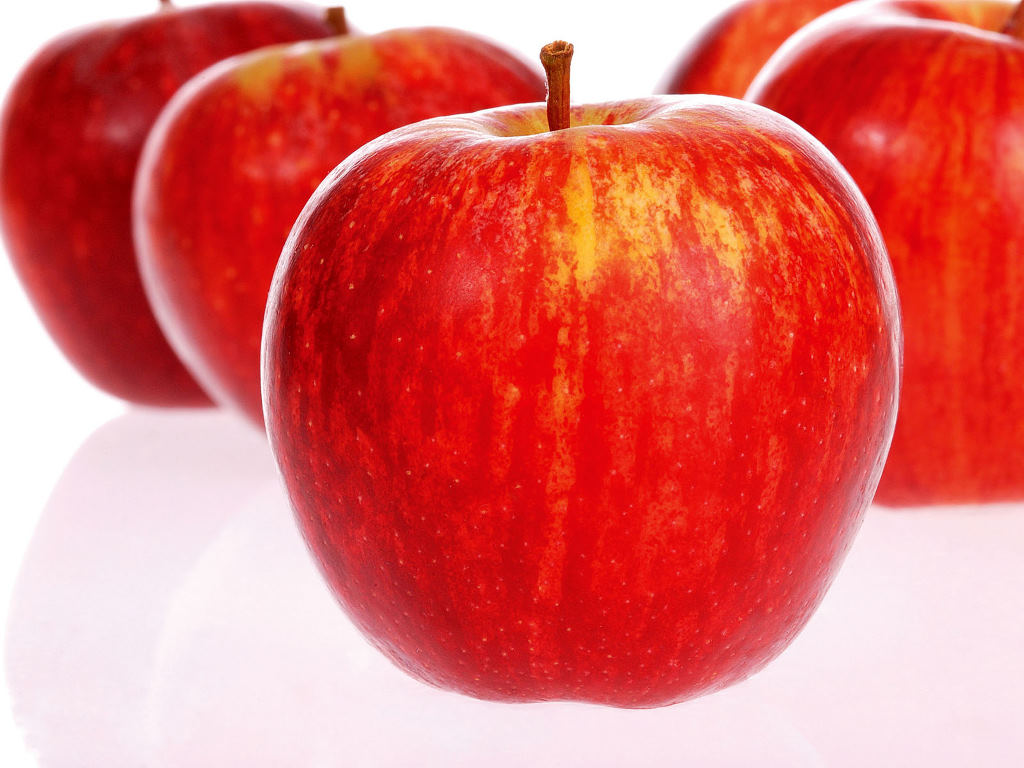
Showing posts with label Apple. Show all posts

Saturday, 22 December 2012

25 Quotes About Apples


"If you want to make an apple pie from scratch, you must first create the universe." -- Carl Sagan

"Millions saw the apple fall, but Newton was the one who asked why." -- Bernard M. Baruch

"Why not upset the apple cart? If you don't the apples will rot anyway." -- Frank A. Clark

"We are born believing. A man bears beliefs as a tree bears apples." -- Ralph Waldo Emerson

"Stay me with flagons, comfort me with apples: for I am sick of love." -- Song of Solomon 2:5

"Anyone can count the seeds in an apple, but only God can count the number of apples in a seed." -- Robert H. Schuller

"Even if I knew that tomorrow the world would go to pieces, I would still plant my apple tree." -- Martin Luther

"Did perpetual happiness in the Garden of Eden maybe get so boring that eating the apple was justified?" -- Chuck Palahniuk

"The sweeter the apple, the blacker the core. Scratch a lover and find a foe!" -- Dorothy Parker

"When the apple is ripe it will fall." -- Irish proverb

"Ever since Eve started it all by offering Adam the apple, woman's punishment has been to supply a man with food then suffer the consequences when it disagrees with him." -- Helen Rowland

"Good apple pies are a considerable part of our domestic happiness." -- Jane Austen

"In Hollywood, the women are all peaches. It makes one long for an apple occasionally." -- William Somerset Maugham

"The revolution is not an apple that falls when it is ripe. You have to make it fall." -- Che Guevara

"I tell you, all politics is apple sauce." -- Will Rogers

"Almost all wild apples are handsome. They cannot be too gnarly and crabbed and rusty to look at. The gnarliest will have some redeeming traits even to the eye." -- Henry David Thoreau, Wild Apples
"From my experience with wild apples, I can understand that there may be reason for a savage’s preferring many kinds of food which the civilized man rejects. The former has the palate of an outdoor man. It takes a savage or wild taste to appreciate a wild fruit." -- Henry David Thoreau, Wild Apples

"Surely the apple is the noblest of fruits." -- Henry David Thoreau, Wild Apples

"It is remarkable how closely the history of the Apple-tree is connected with that of man." -- Henry David Thoreau, Wild Apples

"The flowers of the apple are perhaps the most beautiful of any tree's, so copious and so delicious to both sight and scent." -- Henry David Thoreau, Wild Apples

"What a healthy out-of-door appetite it takes to relish the apple of life, the apple of the world, then!" -- Henry David Thoreau, Wild Apples

"Thy breath is like the steame of apple-pyes." Robert Greene (1590), Arcadia

"Pessimism is as American as apple pie - frozen apple pie with a slice of processed cheese." -- George Will

"My dear, since Eve picked the apple no woman’s ever been taken entirely unawares.... When a woman’s kissed it’s because, deep down, she wants to be kissed." -- Philip Dunne

"Why do we need so many kinds of apples? Because there are so many folks. A person has a right to gratify his legitimate taste. If he wants twenty or forty kinds of apples for his personal use…he should be accorded the privilege. There is merit in variety itself. It provides more contact with life, and leads away from uniformity and monotony." -- Liberty Hyde Baily

Tuesday, 27 November 2012

Dry cold weather affects agriculture and horticulture in Kullu region

Intense dry cold conditions and lack of rainfall in Himachal Pradesh has taken a toll on the Rabi Crop as well as on apples and other fruits.

Dharambir Dhami, an agriculture expert, said: "The weather is cold and dry. It's so dry that children are falling sick and same is the case with old people. It's really difficult. Also, the farmers are suffering. Agriculture and horticulture have taken a severe hit. Apple production has also been adversely affected and farmers incurred heavy loss. Agriculture is in a bad shape, the last season was bad and even this year there is little hope, as farmers have not been able to cultivate wheat as yet."

Dhami also said that apple production would particularly be affected in the low-lying regions of the state.

The dry weather has also affected the production of other crops such as wheat as the growth of the crop is dependent on a good amount of rainfall

Although not cold by the standards of Europe and North America, the drop in temperature can have a devastating effect on the hundreds of thousands of homeless people in India. (ANI)
Original Article Here

Wednesday, 13 June 2012

Farm Bill Has N.Y. Roots


From Honey to Food Stamps, Gillibrand Pushes State Interests in Agriculture Policy
By ANDREW GROSSMAN
WASHINGTON—If Sen. Kirsten Gillibrand has her way, the sprawling, once-every-five-years farm bill being debated here this week will have a New York attitude.
Among her ideas: more fresh produce in places like the Bronx, a safety net for farms growing New York-centric products like apples and even a definition for a burgeoning Brooklyn backyard product, honey.
The efforts are part of a broader push by Ms. Gillibrand, a Democrat, to shift American food and agricultural policy using her position as the first New Yorker in four decades on the Senate Committee on Agriculture, Nutrition and Forestry. The committee shapes the farm bill and has jurisdiction on issues ranging from futures markets to food stamps. Most of its members are from the Midwest and South, leading to a focus on protecting large farms that grow commodity crops such as corn, wheat, rice and soybeans.
"Most people don't look at New York and realize that it's an agricultural state," Ms. Gillibrand said in an interview. "We have a fundamental interest in what does agricultural policy say and how is it shaped."
Ms. Gillibrand's agenda is more complex than that of many of her agriculture committee colleagues. She represents a state with lots of agriculture and a large dairy industry, but no dominant crop. Meanwhile, New York has more people relying on food stamps than every state except three.
Ms. Gillibrand got her start in agriculture issues when she served in the House of Representatives, where she represented a largely rural upstate district. She was appointed to fill Hillary Clinton's seat in 2009 when the former first lady became secretary of state. She easily won the race to fill out the rest of Mrs. Clinton's term in 2010 and is heavily favored in this year's election, which would give her a full six-year term.
She also has a personal interest in food, which she often discusses in the context of taking care of her two young sons, Henry and Theo. During a recent interview in her Capitol Hill office, Ms. Gillibrand said she does her family's grocery shopping and tries to get her boys to eat healthier by awarding them points for eating fruits and vegetables. "I'm a mom," she said. "And I worry about my kids getting the kinds of foods that will help them grow."
Original Article Here

Friday, 1 June 2012

Bani apple finds no buyers


Shiv Kumar PadhaIt is globally acknowledged that the whole of Jammu &Kashmir state abounds in natural beauty and is known as the orchard of Asia, where Ladakh is known for its unique geographical characteristics, topography and the kind of world famous dry fruit, Jammu and Kashmir regions are known for thick grooves of forests, vast stretches of snow, rattling brooks, high pine trees, lush green meadows and pastures, springs with crystal clear water, snow clad mountain peaks and the seasonal fruit like apples, baggu gosha, cherry, khobani, peaches and saffron etc.
So far as the production of the seasonal fruit like apple and gosha etc. is concerned Bani area is in no way behind its counterpart Kashmir .Both Kashmir and Bani apples are known for their crispiness' juiciness and sweetness with the difference that the Kashmir apple looks lustrous, shining, healthy and are marketed in standard packing which fetch good returns for apple growers, whereas Bani apple looks very rough, ugly, spotted and full of scars because they suffer from many diseases like canker which is transmitted through the bark of the tree and cause sunscald or fire blight infection, fruit spots and rots where fungi cause superficial spots or specks on fruit surface, chlorosis - a common disorder of apples, crabapple and mountain ash which leave the leaves yellow and small, root injury and damage caused due to the root disturbance upsetting the supply of air and water needed for the tree. No doubt these diseases do not affect the eating quality of the fruit, they, however, are not presentable before the customers in the market. It seems very humorous that on the one hand, state government is vociferously clamouring to boost the fruit specially the apple industry in the state and, on the other, it is totally neglecting the quality improvement of Bani area apples. Does it mean that the popular state government is committed and serious about the development of apple orchards of Kashmir only? It is very strange that there is no such agency in Bani area which can educate the apple growers about the common diseases of the apples, their treatment and use of proper and timely use of pesticides. In the absence of guidance and expert assistance from the horticulture department the apple crop of Bani is completely left at the mercy of God from blossoming to the fruit bearing stage. During the development of the fruit on the tree no care is taken of the fruit and the tree .
This crop is reared like the crop of maize, wheat and other cereals .The apple growers of Bani area are totally ignorant about the common and special kind of diseases which destroy the apple crop on the tree. Due to the lack of knowledge about the common disease of the apple crop and their treatment, the growers take their yield wrapped in gunny bags to the nearby markets of Basohli, Mahanpur and Billawer where their produce of apples is sold at throw away price rendering heavy losses to the apple growers. It will be worth mentioning here that these trees have been brought by some enthusiastic persons of Bani area from Himachal Pradesh and were planted about 20 years ago. Since then no government agency did take interest in apple crop of Bani nor new trees of superior quality have apples been planted in the area, with the result, the orchard owners are still harboring upon the old techniques of nurturing the apple crop in the area.
On the contrary, the apple industry of Kashmir gets VIP treatment at the hands of Jammu and Kashmir government. In order to bring Kashmir applie apples on international standards, Government provides them all facilities and provides them pesticides and other items on war footing basis. The government advances loans to the apple growers for standardized packing, arranges for the transport of apples to the remotest markets of the country and that of the world, provides insurance facility for the apple orchards. The whole apple season of Kashmir is monitored strictly in terms of transportation of the produce and its marketing.
It is encouraging that in spite of discrimination of apple crop of Bani by the concerned departments of the state, it is still competing with the apple industry of Kashmir and that of Himachal Pradesh. The farmers and owners of apple orchards of Bani are hard working and intelligent, a small assistance by the horticulture department of the state can result into the flourishing and excellent quality of the apples in the state. It is therefore, emphasized upon the state government to
* Take along all the segments of the state together in the matter of progress and development.
* Pay attention to the apple crop in the Jammu segment in general and Bani area in particular. Appoint an expert team to look after the apple crop provide assistance in the treatment of disease of the apple crop and suggest curative measures in order to get good quality apples.
* Appoint team of experts and scientists and establish a research laboratory in Bani area to develop new species of apples and monitor the growth of apples from blooming stage to the harvesting.
* Help provide cheap loans to the apple growers of Bani in order to enable them purchase medicines and pesticides for the protection of their crop.
* Provide them with sophisticated type of packing devices and market for selling their produce easily and with dignity.
* Special economical packages and funds aimed at the development of the various kinds of orchards in the state be made available to the farmers of Bani area so that they can start their vocation a fresh and become economically self sufficient.
It is high time and also the demand of the hour to consider the problems of the apple growers of Bani area seriously and device some means and strategy so that the apples of Bani and that of the valley can attract a good number of customers in the national and international markets.

Apple crop in Kashmir


By Sarbjit Singh Reen
Apple crop in Kashmir is still safe as global warming effects r coming late here. The average height of Kashmir valley 1850 meters, and location are the main plus points. Had it been closer to equator, may be having same height, then the situation would have been more alarming. We are very lucky in that way almighty has provided very good location and height to paradise on earth. Is there something to worry? Let’s check it out.
Himachal Pardesh
According to G C Kuniyal, senior scientist at the GB Pant Institute of Himalayan Environment and Development, Himachal unit at Mohal, "In Kullu valley alone, it's become warmer on an average of 0.9 degree celsius from 1965 to 1998. In 1965, the apple belt was found at a height of 1000m above sea level. Now, it's at 2000m above sea level." Apple, which was grown at Bajaura (1000m) area some years back, can now be found only in Katrain (2000m) near Manali." Warmer climate has made it harder to get a decent crop in the lower and middle elevation belt and apple orchards have shifted to higher altitudes to find a cooler place to grow. Bajoura, located in the lower part of the Kullu valley, produced good quality apples about a few decades ago. Today, there is a general consensus that the lower limit of apples has now reached Raison about 30 kilometers up the valley. Similarly in the Kotgarh region, villages in the middle elevation belt produced some of the finest apples during the 1970s and early 1980s. Today farmers here are struggling to replace their orchards. A similar trend is noticed elsewhere in the state.
Japan
Most of apple trees have been cultivated in the northern part of temperate zone in Japan, since they are suitable for planting in cold climates. The crops produced in a cold area may be greatly influenced by warming. This study is undertaken to assess the impact of global warming on the production of apple (Malus domestica Borkh.) in Japan. The temperature ranges assumed to be appropriate for the cultivation of apple are 6-14°C on annual mean temperature and 13-21°C on mean temperature from April to October, respectively. It was predicted that the favorable regions to cultivate apples will gradually move northward. All the plains of southern Tohoku in 2040's and central Tohoku 2236 meters above sea level in 2060's will be unfavorable for apple cultivation, while most of regions in Hokkaido 1600 meters above sea level will be suitable by 2060's. Many parts of the current apple producing districts in Japan will be possibly unfavorable by 2060's. Therefore, global warming will greatly affect the cultivation environment of apples in Japan by the middle of the 21st century.
Pennsylvania
Adams county is the heart of apple growing. Macintosh, Granny Smith, and other popular varieties flourish here. Apples are among several types of fruit which require a certain number of hours of winter chill to properly set fruit. The report notes that between 800 to 1,200 chilling hours are necessary for most types grown in the state. If the higher-emissions scenario continues, only about 50-60% of the winters in the southeastern part of Pennsylvania, including Adams County, would have 1,000 chilling hours by mid-century. By late century, only the northern-most counties would have enough cold hours to produce apples.
From here we can predict that apple belts will shift if we don’t address this problem of global warming very seriously. we should also make global warming impact assessment teams in Kashmir to access the trend of rising temperatures so that future strategies should be worked out and new cultivars( low chilling) if to be planted can be properly recognized and trails can be made well in time. Two year from Dec3 to Dec 6 a seminar regarding the introduction of new low chilling varieties was conducted in Himachal and foreign delegates from Newzeland and other countries participated in that. In Kashmir as well things r changing, rice belts of Kashmir r shifting to apple cultivation. This is the first symptoms secondly canker attack apple trees has increased many folds , this is an another serious symptoms.

Fruits Grown in Containers


By Sarbjit Singh Reen


Peach, plum , dwaraf plants of apple, pomegranates and papaya can be suceessfully grown in containers.

Sunday, 27 May 2012

Scab - Apple Orchards Diseases


By Sarbjit Singh Reen
Scab is not the only problem in Kashmir and Jammu apple orchards, the farmers in Kashmir know well the means and ways to tackle scab. There are other diseases like Mosaic, cankers root rots which have now become the main headache for growers and extension workers. For the last so many years we have spraying chemicals to control scab and still we are doing so. Every year farmers report that this chemical is not now effective as it quality is not good now but nobody studies the exact cause of it. Fungicide resistance is an important subject to talk about in such circumstances, but this all can become possible with the excellent support of research institutes. What we require is
1 efficacy charts of different fungicides against different diseases of apple.
2. Tank mixing of different fungicides, site selective with broad spectrum so as to minimize resistance development.
3. proper identification and proper time of the emergence of different pests in different locations of kashmir so that timely pest sampling can be done and percent damage can be calculated and proper control measures can be started well in time.
4. most of the Kasmir areas fall in temperate climate but areas of lower altitude which exists in Kupwara(Karnah and teetwal) there such varieties of apple ie red delicious are not successful. This area I think falls in mid temperate zone and is between 900 to 1450 meters here both sub tropical plants and temperate plants can survive but good yields are not possible from both of them. Calculation of chill hours in these areas is must and accordingly varieties suitable for these areas should be identified.
5 canker and its management is essential and for that dormant sprays of copper oxycholoride should be included in spray programmes.
6. our research institutes should now gear up and come up with some great work that can really help the farmer community.

Monday, 21 May 2012

Apple - Fruit


By: Barbjit Singh Reen
Apple is the important temperate fruit of India and India produces about three percent of the total production of the World. Eighty four countries are producing Apple and India stands eighth in apple production and in productivity its place is 53rd in the World. Belgium, Holland and Denmark have productivity more than 40 tonnes per hectare where as our productivity is usually between 6-8 tonnes per hectare.
In India Jammu and Kashmir state is at the top both in production of apple and its productivity (10.1 tonnes/ ha). Other states in India has productivity below 5 tonnes/ ha. (Arunachal Pradesh 2.39 tonnes/ ha, Himachal Pradesh 4.30 tonnes /ha)
In Jammu and Kashmir apple is mostly grown in Kashmir division where productivity in 2008-09 was 10.91 tonnes/ ha and Jammu region has productivity of 1.40 tonnes / ha. Its productivity in 1974-75 was 4.2 tons per hectare and reached to 9.51 tons per hectare in 1992-93 and from then to 2007-08, it is still between 9-11 tons per hectare. But in comparison to countries like Belgium, Holland and Denmark where productivity is more than 40 tons per hectare our achievements are good but still has got great scope for improvement..
Baramulla district has shown some good performance and its productivity in the current year was between 19-20 tons. It gives us the hope that productivity 20 tons per hectare is achievable with the existing orchard system. As most of orchards in Baramulla District has reached their peak production lavels or have crossed their non bearing stage so productivity is high there but in other districts like kupwara, Bandypora plantations are still young so we hope the productivity will increase as the time passes when these plantations will become young enough to produce excellent crop. Total area under apple in Kashmir division is 120542(2009) hectares. It is not possible replace these orchards with high density orchards in single year but our next step should be to replace old and senile orchards with high density plants where ever possible. As the high density orchards have shallow root system and are unable to withstand the rain fed conditions. Creation of assured irrigation system in Apple growing belts of Kashmir will take some more time. These above mentioned problems should be tackled in long term planning but our immediate short term plan achievable in next five years should tackle problems like lesser fruit set, creating awareness among orchardists regarding spray schedules, pests and diseases and their management and awakening consumers about the established benefits of Apple products over carbonated Beverages. If achieved this plan should definitely double our production with in 5 years.
. Causes of low productivity.
• Apple flowers have both male and female parts but yet most of the apple varieties are self unfruitful and require pollen of some other variety to get fertilised and set good crop. Flowering period of both the varieties should overlap only then this pollination is possible. For successful pollination in Apple 33% pollinizers (Other variety trees which produce good pollen) are required. But most of the orchards in valley have pollinizers percentage less than 10%.
• Population of Honey bees have declined due to excess use of pesticides at bloom stage. Wind plays very little role in apple pollination because of the sticky nature of Apple pollens.
• The less population of both pollinators and pollinizers are mainly responsible for poor fruit set in apple crop.
• Poor training and pruning of trees also contributes to low fruit set and poor quality fruit.
• Red delicious is the major variety in Kashmir and contributes 60% of the production and is alternate bearing in nature which contributes to low productivity in off years
• Orchards which are grown in paddy lands are usually affected diseases like Root rot and Collar rot.
• Canker treatment and its awareness among people should be at our top priority .
• Spring frost and chilling atmosphere at flowering time is dangerous for fruit set.
• Compatible fungicides with insecticides are now mentioned in Horticulture Departments spray schedule we should try hard to popularize it..
• Control of scab and other fungal foliar diseases increases the cost of production of apple which most of the times unaffordable to the poor farmers
• The extent of loss is reported to be about 14% of the total apple production in India which amounts to 182000 tonnes and 100 crores in terms of money, for want of suitable infrastructure.

LinkWithin

Related Posts Plugin for WordPress, Blogger...