Saturday, 6 April 2013

MIA: Macedonian agriculture to adapt to climate change

Skopje. A new World Bank book on the impacts of climate change on agriculture in the Europe and Central Asia region indicates that projected changes in temperature and precipitation in the Republic of Macedonia are expected to increase the vulnerability of the country’s agriculture sector and rural population if no action is taken, Macedonian MIA news agency informed.
The book, Looking Beyond the Horizon: How Climate Change Impacts and Adaptation Responses Will Reshape Agriculture in Eastern Europe and Central Asia, offers new insights and adaptation options for the agricultural sector in Albania, Macedonia, Moldova, and Uzbekistan.
According to the book, temperatures in Macedonia are expected to increase by as much as 1.8o Celsius over the next 40 years – well above the increase of less than 0.5 o C observed in the country over the last 50 years. These rising temperatures, coupled with changes in rainfall patters across the country, are expected to severely impact agriculture production in the region – with projected temperature increases of as much as 4-5o C in summer, coupled reduced water availability during the key growing period of May-September.
Building on these projections, this book offers impact assessments of climate change on agricultural production in three agro-ecological zones (AEZs) of the country. Medium-impact climate modeling scenarios in this book indicate that projected shifts in crop yields in the country will vary by AEZ and crop. Crop production of commodities such as apples and grapes could potentially decline by as much as 45 percent and 32 percent, respectively. On the other hand, wheat yields – both rainfed and irrigated – are expected to increase across all the AEZs, potentially doubling in some areas.
Original Article Here

Africa: Experts Urge More Agriculture, Climate Change Research


Washington — Experts in food and agriculture are urging policymakers to prepare for future challenges to farm production from climate change.

The International Food Policy Research Institute (IFPRI) in Washington offered suggestions in a report released April 2 to help farmers build resilience to these challenges. The recommendations include combining research aimed at developing climate-resilient crops with that for improving production, strengthening weather and price data collection to help farmers decide what to grow, training farmers in new food production techniques, and incorporating climate change into food security policies.

The report was intended to help make policymakers aware of the uncertainties surrounding climate change and give them guidance on decisions related to developing new crop and livestock varieties, water management strategies and regional trade policies, according to IFPRI senior researcher Gerald Nelson.

He said officials need to make sure that countries have agronomists, soil scientists and livestock specialists who can work with the private sector, international researchers and community groups to address climate change and the need to produce more food. They also need to build roads that can tolerate higher temperatures so farmers can get their products to buyers, he said.

ANOTHER CALL FOR RESEARCH

Agriculture and development expert Robert Thompson, speaking April 3 at Johns Hopkins University's School of Advanced International Studies in Washington, backed Nelson's call for more research to help farmers adapt to climate change and meet the food and nutrition needs of the world's growing population without damaging forests or soils.

Thompson said the World Bank estimates that by 2050 the world's population will increase 40 percent. With increased demands for more types of food by countries' burgeoning middle classes and growing demand for biofuels by oil-dependent countries, farm production will need to double by the middle of the century.

"The challenge of doubling is even greater when effects of climate change are added," said Thompson, former World Bank director of rural development.

He said that climate change will shift global agro-ecosystems, which will expand growing areas in northern regions but may result in more volatile weather conditions. Rising sea levels will claim cropland in some low-
lying areas, he added.

Thompson said research is needed to make agriculture technologies more adaptive to geographic locations. For instance, he said that because climate change is extending the growing season in higher altitudes, research could find ways to help cropland in those regions produce more. Research also is needed to make currently unusable soils productive and to increase the productivity potential of crops and livestock, he said.

Thompson added that water will be another stress on agriculture as rapidly growing cities outbid agriculture for the life-giving resource. More than half of the world's population now lives in cities, he said.

"This will require investments in research to develop water-saving technologies and to increase drought-tolerance and water-use efficiency in crop varieties," he said.

Thompson said cuts in funding for agriculture and rural development made by developing countries and aid donors in the 1980s, and the increased frequency of extreme weather occurrences like drought and flooding halted the progress made in farm production during the 1960s and 1970s. Food price spikes in 2007, 2008 and 2011 brought "a wake-up call" for reinvigorated spending on agriculture, he said.

Nelson's and Thompson's views are backed by the U.S. Department of Agriculture, which in February reported that agriculture and forest management will have to adapt to climate change. USDA said that existing and new conservation practices and research will help agriculture and forestry adapt to climate change.
Original Article Here

Haiti - Agriculture : Agricultural sector very exposed and mostly uninsured...

Agriculture employs a fifth of workers in the Caribbean and generates a significant income for the region. Many countries are highly vulnerable to natural risks and defenceless against price swings. Nonetheless the industry remains, in the main, uninsured against major shocks. These are the findings of a new World Bank report, "Agricultural Risk Management in the Caribbean"’, which details the experiences and lessons learnt in the region between 2009 and 2012.

In the past 20 years, Caribbean countries have, each year, spent between 1 and 9% of their GDP dealing with the effects of weather hazards.

With the exception of the banana industry in the Eastern Caribbean and a public insurance company in the Dominican Republic, agricultural insurance against natural disasters is non-existent in the region.

According to the Food and Agriculture Organization (FAO), in 8 Caribbean countries 90% of the farms have less than 10 hectares and grow multiple crops. These small farms represent over half of the available agricultural land. Therefore, making affordable insurance available to all those small-holders has proved highly problematic.

The World Bank whick is working to overcome some of these limitations, in 2007, the Bank launched the Caribbean Catastrophic Risk Insurance Facility (CCRIF) to help countries fund early reconstruction following natural disasters such as hurricanes and earthquakes. Covering the first few months after a disaster, claims are paid to participating governments based on the type of event rather than by assessing actual losses allowing for transparency and low-settlement costs. Following successes in Africa and Asia, the Bank has supported countries in beginning to implement market-based instruments, such as insurance and price-risk management, in the agricultural sector.

Situation in Haiti
Due to its location in the Caribbean basin, Haiti’s agricultural sector is exposed to major climatic hazards. In addition, the deterioration of the environment has contributed to increased natural risks as well as droughts and floods.

Haitian crops were severely affected during 2008 by four storms that caused direct damage estimated at around US$200 million. The 7.0 magnitude earthquake in January 2010 affected mostly urban areas, but also caused losses on the agricultural sector of around US$31 million.

In addition, the very low level of public and private investment in agricultural infrastructure make it virtually impossible to put in place strategies that would prevent or help to minimize the risks or consequences of a natural hazards. For example, lack of watershed protection and deficiencies in irrigation are major causes of floods and droughts. Finally, the weak fiscal position of the Government restricts the funding for response and preparedness to these events.

The study makes a few recommendations in order to reduce the vulnerability of Haiti-s agricultural sector.

It would be important to increase public funds dedicated to emergencies, with a roll-over mechanism; that is, for the years that the funds are not being used, the extra money would continue to accumulate.

The document emphasizes that predetermined rules for disbursement would be important in order to reduce corruption.

The data of the global agriculture census could register vulnerable farmers, helping the authorities to identify those most affected by natural events.

It also recommends strengthen the quality and quantity of weather data, as well as invest more in infrastructure and improve the regulatory and legal framework for the development of market-based instruments for agricultural risk management.
Original Article Here

How women leaders engage communities in winning ways

More and more Filipinas are seen in top positions, but there are plenty of women leaders in less visible areas, such as agriculture and education. With a bundle of fresh vegetables, or a piece of chalk in hand, they make a difference in their communities, learning important lessons along the way.

Treat everyone equally

"If you want something, aim for it, taking into consideration na dapat wala ka namang tatapakan na tao," said Lani Linpin, executive director of Organic Certification Center of the Philippines (OCCP).

For Linpin, the most important thing is to treat everyone equally, regardless of gender. "Kasi, once we look at gender differences, that's where discrimination comes in. Kapag nagkaroon ng discrimination, doon din nagkakaroon ng pagbabago sa orientation natin on how we decide things," she said, comparing gender discrimination to racism.

"The color of the skin doesn't tell you anything. We're still all people. We can all think, we can all decide," she said.

Learn to be hands-on

Linpin recommended learning through interaction, based on her own experience doing fieldwork, instead of the usual desk or laboratory jobs that many female agriculturists prefer. According to Linpin, doing fieldwork allows you to interact more with people, which allows you to gain more knowledge.

"'Yung pagkuha mo ng info sa books, sa internet, anybody can do that. Everybody can read, and relatively everybody can access that information. Pero bihira yung kukunin mong information direct sa farmer, and that's what excites me most," she said.

Before joining OCCP, Linpin was engaged in NGO work, implementing organic agriculture in the early 1990s.

"Wala pa siyang hype noon, sustainable agriculture ang talagang pinopromote at that time. It was only in the late 1990s when organic agriculture started in the country," said Linpin, whose work wioth OCCP involves formulating organic standards, inspection procedures, and training.

Partnership and openness

By working with women in a rural setting, she realized that women should become more involved in the farm, in terms of decision making as well as active control over resources. Linpin recalled that when it came to teaching the farmers about new technology, it was mostly the men who would be around, and women would only come in when the men were absent.

Realizing that the women were not always able to transfer the information to the men, they began to analyze gender roles in farming.

"Who does what, babae o lalake? Pareho ba sila? And then we processed that to come up with who can decide over what," Linpin said, adding that it would take at least a year before they could see changed in the decision making process. "First gather the women, and after mo sila ma-process, you gather them both. And then you process again, para pareho nilang naiintindihan na hindi ka nandoon para sabihin na 'Hoy! Magaling

din ako.' Kasi they have to view themselves as partners," said Linpin, who did a study on gender relations, which served as a guide for future projects.

Linpin was also a member of Sarilaya, a women's organization, before joining OCCP, which began its certification business in 2005. Based on her experiences, Linpin said that when it comes to women empowerment, it is important that the male partner is also open to learning.

"Kung hindi open ang lalaki o kung sino man ang partner niya, mahihirapan siya to exert effort na 'karapatan ko na makihalo sa desisyon, karapatan ko na magkaroon ng access sa pera natin, 'di lang ikaw dapat ang nagsasabi kung anong gagastusan, karapatan ko na ano yung puwede ko namang bilhin para sa sarili ko,'" she said, noting that women commonly think of others, but forget to take care of themselves.

"Kung magkakaroon ng women empowerment na hindi open si partner, magkakaroon ng power play sa loob ng pamilya, and that will not be healthy. Maghihiwalay naman," she said.

Nature and nurture

For Char Tan of Good Food Community, working with farmers, teammates, and the people who subscribe is a gift. "I think to be able to build a culture that nurtures people has been most meaningful to me," said Tan, who started the community with her teammate, Tricia.

Good Food Community was built on the concept of community-shared agriculture, which creates a relationship between the people who grow the food and the people who eat the food. Households pledge to support farm operations, and in turn receive a share of the harvest. On the other hand, farmers can rely on a stable demand.

"For the nanays, what is most apparent is the income that they get every week from the sale of veggies, which does help a lot in household, educational and medical expenses. I also hear that they're getting a lot of exercise tending to the veggies -- waking early, watering the plants, preparing the soil, harvesting and preparing vermicompost or other natural fertilizers," shared Tan.She added that the community has also made those involved more aware of their health in general.

Engage and just do it

For Tan, being female was not an issue in building the community. For women who are inspired to start something on their own, her advice was to just do it. "Whatever obstacles will be there whether or not you engage them so you might as well blaze the trail, scale the thing. Show it can be done," she said.

She also recommended keeping in touch with like-minded individuals. "I've had the gift of great friends to journey with. Many great women, come to think of it. I guess that's one reason why I haven't felt much gender-related resistance. The women around me take all that as traction for whatever it is they're moving towards," she said.

Lastly, Tan agreed with having "a room of your own." "That is, I suppose, to listen carefully to your truth before others' ideas of who or what you should be," she said.

A different kind of leadership

One doesn't have to be in a high position to make a difference. As a B.S. Biology graduate, Sabrina Ongkiko discovered she could lead others by serving through downward access. Ongkiko had wanted to become a doctor, but decided to become a public school teacher.

“Teaching gave me a different view on leadership. Teaching is all about standing there in front of your students and guiding them towards their dreams, their goals. That's a different kind of leadership,” Ongkiko said in a video by Teach for the Philippines.

She explained that instead of pitying her students, she began to understand where they were coming from: “Because when you pity them, it's like you're telling them you're still above them. But as their teacher, if I am above them, I can't help them move up. I need to go down lower so I can push them up,” she said.

Although it was not the return on investment that her family had counted on getting by sending her to an expensive school, she realized that going into teaching resulted in a different kind of wealth.

“When I stand there and look at the faces of these kids, that for me is very powerful. Hearing their dreams and working with them to reach those dreams. That's really what I want my life to be about,” she said. – KDM, GMA News
Original Article Here

Friday, 5 April 2013

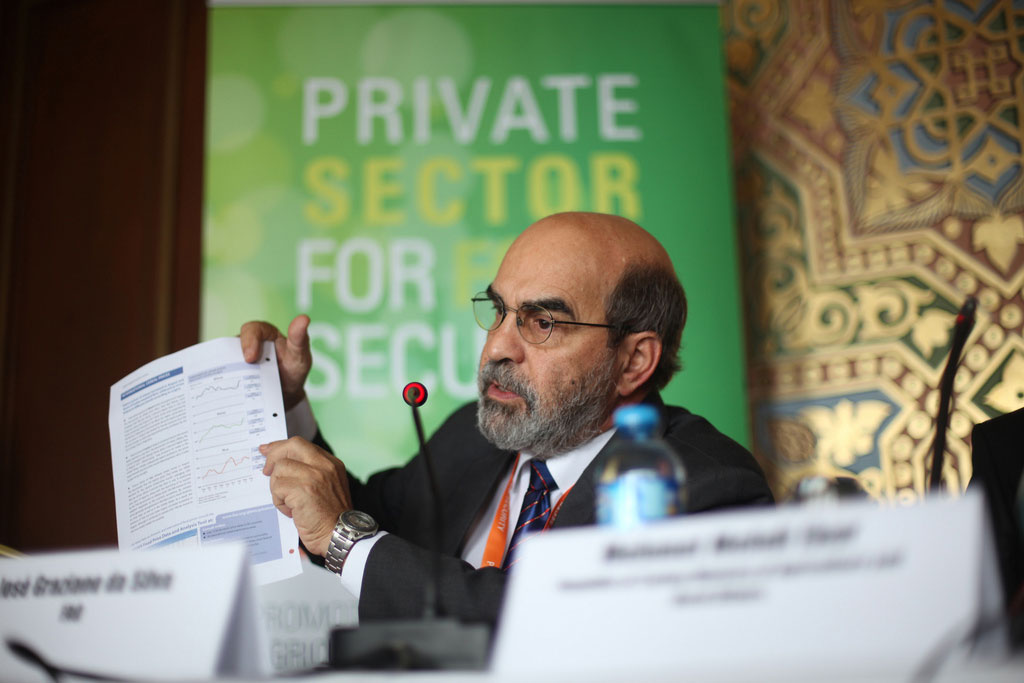
Private sector role in agriculture stressed


He also celebrated more than 50 years of US-Pak cooperation in the agriculture sector–a partnership that contributed to the Green Revolution of the 50’s and more recently has increased incomes for 800,000 families over the last three years.


The expo highlighted new technologies and development projects being implemented in Pakistan through the collaborative efforts of international donors, private sector companies, and Pakistan’s government. These efforts are focused on creating jobs, increasing farmers’ incomes and improving Pakistan’s food security.


Speaking at the expo, Ambassador Olson emphasised that the private sector must be involved for development assistance to be effective. “The challenge for Pakistan’s long-term sustainable agricultural development ultimately depends on private sector initiatives to take these programmes and transfer them into viable commercial enterprises,” he said.


Since 2009, the US government has invested more than $230 million to fund projects that support the economic growth of Pakistan’s agriculture sector. At the expo, the US Agency for International Development, the US Foreign Commercial Service and the US Department of Agriculture highlighted many of these agricultural initiatives.
Original Article Here

Thursday, 4 April 2013

Dutch firm to restore SA fishery ships


THE Department of Agriculture, Forestry and Fisheries has signed an emergency contract with Dutch shipyard Damen to bring South Africa’s fleet of six fisheries patrol and survey vessels into operation.


The department reclaimed the vessels from the navy after the latter failed to ensure that they carried out their duties of patrolling and quantifying the sustainability of South Africa’s fishing stocks.

Because of the degeneration of the ships while under the navy’s control, they lost their Lloyds of London insurance class. The department now has had to obtain special permission from the Treasury to effect the "emergency" repairs to get them seaworthy again.

Damen built some of the ships six years ago, including the largest, the Sarah Baartman, which is mainly used for long-endurance fishing protection patrols.

The shipyard will also return to service the Afrikaner, the survey ship used to measure and determine the sustainability of South Africa’s fishing stocks. If South Africa was to lose its Marine Stewardship Council certification, it would not be able to export fish to key markets such as Europe.

Those exports are worth about R6bn annually to the economy.

The department’s deputy director-general for fishing, Greta Apelgren-Narkedien, said the estimated cost of the repairs for all six vessels was about R5m, which was far less than originally expected. This did not include the cosmetic upkeep such as painting.

The vessels, apart from the Afrikaner, were relatively new having been built between six and eight years ago. "The other thing is that Damen originally built the patrol vessels and so they know them well," Ms Apelgren-Narkedien said.

The repairs were being carried out and funded in terms of a National Treasury directive that allowed for emergency funding as long as both the Treasury and the auditor-general were informed in time. "We’ll inform Treasury and the auditor-general of the funding being allocated for the repairs this week," Ms Apelgren-Narkedien said.

"In terms of the directive, we only have to inform them once the contract has been signed ."

Tim Reddell, deputy chairman of industry association Fish South Africa, said the contract between Damen and the department was good news, but was only the first step of several that had to be taken to get the ships operating regularly again. The ships would have to be crewed properly with people who understand and have proper knowledge of sea conditions and the vessels themselves.

"The crewing and management of these ships have to be done by a company of substance," Mr Reddell said. "That company must have the proper operational management such as an operations room and communications infrastructure ."

The estimated operating costs of the ships was about R100,000 a day while at sea, and they were expected to spend about 200 days at sea a year, Mr Reddell said.

Ms Apelgren-Narkedien said a short-term contract for the crewing of the ships might be signed as early as tomorrow and a longer-term one later this month.
original Article Here

Kentucky Agriculture Commissioner James Comer to fire top official


FRANKFORT, KY. — A top official in state Agriculture Commissioner James Comer’s administration who also worked for embattled former Commissioner Richie Farmer is being fired, a spokeswoman for Comer said Wednesday.

At a news conference to announce the closing of a controversial fuel-testing lab that Farmer started, Comer said Deputy Commissioner Bruce Harper — who already was on unpaid leave at his request to deal with ethics charges — was given the option to resign or be fired.

Later in the day, Comer chief of staff Holly Harris VonLuehrte said Harper was being dismissed.

Comer declined to say why Harper was given the ultimatum.

Harper, who also was deputy commissioner under Farmer, faces three ethics charges by the Executive Branch Ethics Commission that accuse him of improper soliciting of donations for an agriculture commissioners’ convention and interfering with department enforcement actions for political reasons.

He is one of eight people charged with ethics violations stemming from Farmer’s eight-year tenure as Kentucky’s agriculture commissioner. Farmer, a former University of Kentucky basketball star, himself faces a record 42 charges that allege he used his tenure for personal gain.

Harper, who has been an at-will employee not in the state’s merit system, did not return a phone message seeking comment.

The ethics charges followed an audit of the department that Comer, who took office in 2011, requested because of questions regarding Farmer’s management of the agency, including hiring a girlfriend.


Comer named Larry Cox to be the new deputy secretary. Cox had been executive director of Comer’s office of consumer and environmental protection and previously worked for U.S. Sen. Mitch McConnell, R-Ky.

The fuel lab drew criticism from legislators after Comer found that cost savings Farmer promised when he started the lab more than five years ago didn’t materialize. Farmer had said the lab could make money by testing fuel for other states.

“I can see where it would seem like a good idea, but there was never a business plan,” Comer said. “There was never any business development. It was just a pie-in-the-sky idea.”

The lab contains $3.1 million in equipment and cost $900,000 a year to operate — including almost $200,000 a year in rent — until cuts were made under Comer. The lab is down from nine employees to one, a chemist who will remain with the department.

The new contractor testing will cost about $330,000 a year, for annual savings to the department of about $600,000.

Comer said the changes will have no impact on consumers at the pump or the department’s legal requirement to test fuels.
Original Article Here

LinkWithin

Related Posts Plugin for WordPress, Blogger...