Saturday, 28 April 2012

Essential and Non essential Amino acids

Essential amino acids:-
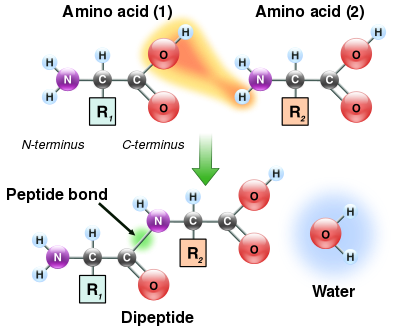
Most micro organisms such as E. Coli can synthesise the entire basic set of 20 amino acids, whereas human beings cannot make 9 of them. The amino acids  that must be supplied in the diet are called essential amino acid.There names are as followed

1.         Histidine
2.        Isoleucine
3.       Leucine                             
4.       Lysine
5.       Methionine 
6.       Phenylalanine
7.       Threonine
8.        Tryptophan
9.       Valine

Non essential amino acid:-
The  amino acid which are produced in the body are called non essential amino acid.These are  the following:-

1.         Alanine
2.        Arginine
3.       Asparagine                               
4.       Aspartate
5.       Cysteine                                    
6.       Glutamate
7.       Glutamine
8.        Glycine
9.       Proline
10.     Serine
11.       Tryosine  

Soil Order Names and Their Formative Elements


Soil Order Names and Their Formative Elements
Order 
Formative
Element 
Derivation 
Mnemonicon
Entisol 
ent 
(nonsense syllable)
recent
Inceptisol 
ept 
L. - inceptum, beginning 
inception
Aridisol 
id 
L. - aridus, dry 
arid
Spodosol 
od 
Gr. - spodos, wood ashes
podzol; odd
Ultisol 
ult 
L. - ultimus, last 
ultimate
Mollisol 
oll 
L. - mollis, soft 
mollify
Alfisol 
alf 
(nonsense syllable) 
pedalfer
Oxisol 
ox 
Fr. - oxide, oxide 
oxide
Histosol 
ist 
Gr. - histos, tissue 
histology
Vertisol 
ert 
L. - verto, turn 
invert
Andisol 
and 
Sp. - Andes
andesite
Gelisols 
el 
L. - gelare, freeze 
gelifluction


Simplified Key to Soil Orders
If soil has: Order
1. Soils with permafrost within 2 m of the surface Gelisols
2. More than 30% organic matter to a depth of 40 cm Histosols
3. Other soils with a Spodic horizon within 2 m Spodosols
4. Other soils that have andic soil properties in 60% or more of the soil thickness Andisols
5. Other soils with an Oxic horizon within 2m and no argillic horizon Oxisols
6. Other soils with more than 30% clay in all horizons; some cracks when dry at 50 cm Vertisols
7. Other soils that are dry more than 50% of the year and have no mollic epipedon Aridisols
8. Other soils that have an Argillic horizon but has a base saturation <35% at 1.8 m Ultisols
9. Other soils that have a Mollic epipedon Mollisols
10. Other soils that have an Argillic horizon Alfisols
11. Other soils that have an Umbric, Mollic, or Plaggen epipedon, or a Cambic horizon Inceptisols
12. Other soils Entisols

Classes of Soil Temperature Regimes


Classes of Soil Temperature Regimes

Soli temprature is measured by soil thermameter when the depth is specified because its flactuates with the depth, usually 50cm is taken soli temp is depth dependent

Pergillic
When the soil is permanenty frozen condition

Cryic (Gr. kryos, coldness; meaning very cold soils)

Soils in this temperature regime have a mean annual temperature lower than 8° C but do not have permafrost.
In mineral soils the mean summer soil temperature (June, July, and August in the Northern Hemisphere and December, January, and February in the Southern Hemisphere) either at a depth of 50 cm from the soil surface or at a densic, lithic, or paralithic contact, whichever is shallower, is as follows:
If the soil is not saturated with water during some part of the summer and
If there is no O horizon: lower than 15° C; or
If there is an O horizon: lower than 8° C; or
If the soil is saturated with water during some part of the summer and
If there is no O horizon: lower than 13° C; or
If there is an O horizon or a histic epipedon: lower than 6° C.

In organic soils the mean annual soil temperature is lower than 6° C.

Cryic soils that have an aquic moisture regime commonly are churned by frost.

Isofrigid soils could also have a cryic temperature regime. A few with organic materials in the upper part are exceptions.

The concepts of the soil temperature regimes described below are used in defining classes of soils in the low categories.
Frigid
A soil with a frigid temperature regime is warmer in summer than a soil with a cryic regime, but its mean annual temperature is lower than 8° C and the difference between mean summer (June, July, and August) and mean winter (December, January, and February) soil temperatures is more than 6° C either at a depth of 50 cm from the soil surface or at a densic, lithic, or paralithic contact, whichever is shallower
Mesic
The mean annual soil temperature is 8° C or higher but lower than 15° C, and the difference between mean summer and mean winter soil temperatures is more than 6° C either at a depth of 50 cm from the soil surface or at a densic, lithic, or paralithic contact, whichever is shallower.

Thermic
The mean annual soil temperature is 15° C or higher but lower than 22° C, and the difference between mean summer and mean winter soil temperatures is more than 6° C either at a depth of 50 cm from the soil surface or at a densic, lithic, or paralithic contact, whichever is shallower.
Hyperthermic
The mean annual soil temperature is 22° C or higher, and the difference between mean summer and mean winter soil temperatures is more than 6° C either at a depth of 50 cm from the soil surface or at a densic, lithic, or paralithic contact, whichever is shallower. If the name of a soil temperature regime has the prefix iso, the mean summer and mean winter soil temperatures differ by less than 6° C at a depth of 50 cm or at a densic, lithic, or paralithic contact, whichever is shallower.
Isofrigid
The mean annual soil temperature is lower than 8° C. diffrence between MST and MWT is less then 5 (summer month are june, july, Agust and winter are Dec, Jan, Feb
Isomesic
The mean annual soil temperature is 8° C or higher but lower than 15° C. diffrence between MST and MWT is less then 5
Isothermic
The mean annual soil temperature is 15° C or higher but lower than 22° C. and the diffrence between MST and MWT is less then 5
Isohyperthermic
The mean annual soil temperature is 22° C or higher. The diffrence between MST is MWT is less then the 5

IPM Defined


IPM Defined
Integrated Pest Management (IPM) is a process consisting of the balanced use of cultural, biological, and chemical procedures that are environmentally compatible, economically feasible, and socially acceptable to reduce pest populations to tolerable levels.
Integrated means that many strategies are used to avoid or solve a pest problem. These strategies come from different disciplines, such as disease information from plant pathologists, weed information from agronomists, and insect information from entomologists.
Pests are unwanted organisms that are a nuisance to man or domestic animals, and can cause injury to humans, animals, plants, structures, and possessions.
Management is the process of making decisions in a systematic way to keep pests from reaching intolerable levels. Small populations of pests can often be tolerated; total eradication is often not necessary.

economic threshold concept


The economic threshold concept is most relevant for decisions that are made when the level of pest attack can be assessed through monitoring. Various measures can be used to assess the level of pest attack, such as the number of pest insects per 10 plants, the percentage of diseased plants in a crop, or the number of weeds per m2. The economic threshold, defined in terms of the level of pest attack, is the level of attack where the estimated benefits of treatment cover the cost of that treatment. If the level of attack is below the threshold, the cost of treatment would exceed the benefits and the farmer would make a loss by applying the treatment.

A simple way of looking at economic thresholds is to start with the cost of treatment. If you can estimate what it costs to apply a pest management treatment, you can then try to estimate what benefit - in terms of reduced yield loss - you would need to gain for treatment to be worthwhile.

Thus, the % crop loss necessary for treatment to be worthwhile = [C/YP(K/100)] x 100%
Where:
C = the cost of treatment,
Y = the expected yield of the crop,
P = the expected price per ton, and
K = the expected effectiveness of the treatment.

For instance, in the Philippines, it would be worth applying a herbicide for weed control if the expected yield loss (without control) was greater than 9%, where - C = 38; Y = 4.5; P = 154; K = 60

Virus attack on Banana (urdu)


Friday, 27 April 2012

Gardens of Lahore , Pakistan


Here are designs of Jinnah Garden Lahore, Polo ground and Shalimar Park. Lahore Pakistan.

LinkWithin

Related Posts Plugin for WordPress, Blogger...