Showing posts with label mechanisation of agriculture. Show all posts
Tuesday, 5 November 2013
Sunday, 8 July 2012
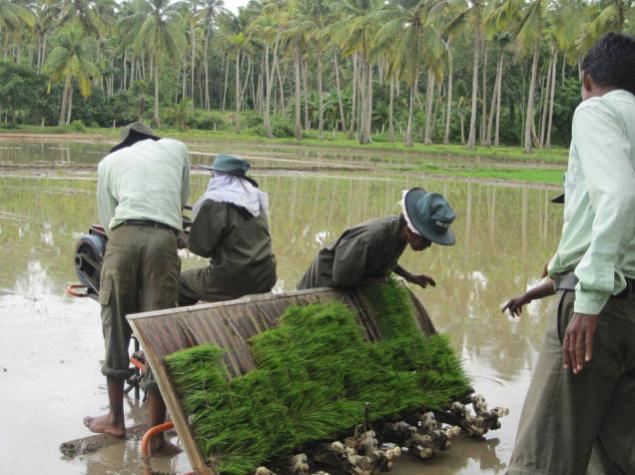
Mechanization key to food sufficiency
By Dexter A. See
An agriculture expert called on authorities
to step up mechanization to achieve food sufficiency and help uplift lives in
the countryside.
Rex Bingabing, director of the Philippine
Center for Postharvest Development and Mechanization, said the upgrade is also
meant to tap markets abroad.
“Compared to neighboring countries, the
Philippines is low in agricultural mechanization resulting in low productivity,
poor product quality and high postharvest losses,” he told Manila Standard.
In terms of horsepower per hectare, Bingabing
said the country’s level of mechanization was 0.52 hp/ha compared to Japan’s 7
hp/ha, China’s 4.1 hp/ha, Vietnam’s 1.56 hp/ha and Thailand’s .7hp/ha.
To feed the growing population that is
expected to hit the 100 million mark in 2016, yield must be maximized and loss
minimized, he said.
PhilMech, an attached bureau of the
Department of Agriculture, aims to provide equipment on an 85/15 percent
counterparting scheme between government and irrigators associations along with
cooperatives and other farmers’ groups.
“We need to change some of our agricultural
practices and technologies to achieve self-sufficiency,” Bingabing said.
Original Article Here
Sunday, 20 May 2012
Give priority to mechanisation of agriculture, farmers told
Two-day Krishi Utsav begins in Katapady
S.A. Prabhakar Sharma, Chief Executive
Officer of the zilla panchayat, said on Saturday that farmers should give
importance to mechanisation of agriculture.
He was speaking at the inaugural function of
the two-day Krishi Utsav organised by the zilla panchayat, Department of
Agriculture, Sri Kshetra Dharmasthala Rural Development Project, and the
Dakshina Kannada Milk Producers' Federation here. Mr. Sharma said the
government had introduced a single window clearance system to provide
technological inputs and agricultural information to farmers. It encouraged
interaction between farmers and scientists to increase agricultural
productivity.
Karnataka was among the most agrarian States
in the country. Changes were taking place in agriculture after the advent of
globalisation and liberalisation in the 1990s. It was essential for farmers to
keep pace with these changes, he said.
Though paddy was the chief crop of the
district, its cultivation suffered because of shortage of labour, high cost of
production, and decline in prices. To help farmers, the government had
announced support price for paddy. In 2011-12, the government purchased 12,500
quintals of paddy in Udupi district, Mr. Sharma said.
Original Article Here
Subscribe to:
Posts (Atom)